Rental Property Tax Deductions: The Year-End Checklist Every California Owner Should Run Before December 31

If you own a rental in Riverside, Corona or anywhere across the Inland Empire, the short answer to "what can I deduct on a rental property" is: nearly everything it costs you to run it. Mortgage interest, property taxes, insurance, repairs, management fees, leasing and advertising, utilities you cover, HOA dues, legal and accounting fees, travel to the property, and depreciation on the building all reduce your taxable rental income. The bigger Q4 question is timing - you have until December 31 to move deductions into this tax year instead of next.
This guide covers the full set of rental property tax deductions, the repairs-versus-improvements line that trips up most owners, the California rules that differ from federal, and an action list to run before the calendar flips.
This is general educational information for rental owners, not tax advice. Nothing here tells you what your liability is or what you should claim. Tax figures change every year - confirm everything with your CPA before you file. Current as of September 2026.
Is rental income taxable? Yes - but you are taxed on profit
Rent you collect is taxable income. So are lease-cancellation payments, advance rent in the year you receive it, and any expense a tenant pays on your behalf. A security deposit you expect to return is not income when received - it becomes income only if you keep it.
But you are taxed on net profit, not gross rent. Subtract allowable expenses first, report the result on Schedule E of your federal return, and that figure flows into your adjusted gross income.
California then taxes that net figure as ordinary income at its graduated rates - there is no preferential rate for rental income the way there is for long-term capital gains. Residents are taxed on rental income wherever the property sits; nonresidents only on California property. That is spelled out in the Franchise Tax Board's guidance on rental income. A rental profit can also trigger the federal net investment income tax, so ask your CPA whether that applies to you.
The deductible expense table
"Deduct now" means the full amount generally comes off this year's income. "Depreciate" means the cost is recovered over a set number of years.
| Expense category | Deduct now or depreciate | Note |
|---|---|---|
| Mortgage interest | Deduct now | Interest only - principal is never deductible |
| Property taxes | Deduct now | County installments actually paid in the tax year |
| Landlord/dwelling insurance | Deduct now | Multi-year prepaid policies get spread over the period covered |
| Property management fees | Deduct now | Ordinary and necessary operating expense |
| Leasing, advertising, tenant screening | Deduct now | Listing fees and background checks |
| Repairs and maintenance | Deduct now | Must keep the property in its existing condition |
| Landscaping, pest control, pool service | Deduct now | Recurring service contracts |
| Utilities you pay | Deduct now | Water, trash, gas or electric covered by the owner |
| HOA dues | Deduct now | A special assessment funding a capital project may be capitalized |
| Legal, accounting and tax prep | Deduct now | Includes eviction filings and Schedule E preparation |
| Travel and mileage | Deduct now | Log every trip; check the current IRS standard mileage rate |
| Supplies, tools, software, permits | Deduct now | Lockboxes, filters, rent-collection software, city licenses |
| The building itself | Depreciate | 27.5 years, straight line - land is never depreciable |
| Roof, HVAC, re-pipe, room addition | Depreciate | Capital improvements to the building |
| Appliances, carpet, furniture | Depreciate (shorter life) | May be written off immediately federally - see the California section |
| Loan origination points and fees | Amortize | Spread over the life of the loan |
| Work done before the unit is rent-ready | Depreciate | Part of your basis, not a current deduction |
Rental property depreciation: the deduction owners under-use
Depreciation is the deduction you take without writing a check. The IRS lets you recover the cost of the building - never the land under it - over 27.5 years, straight line, under the General Depreciation System, using a mid-month convention. The rules are in IRS Publication 527.
Three things owners get wrong:
They forget to split out land. Only the improvement portion of your purchase price is depreciable. Use your county assessor's land-to-improvement ratio or an appraisal, and document how you got there.
They start the clock at the wrong time. Depreciation begins when the property is placed in service - ready and available for rent - not when you bought it and not when a tenant moves in.
They skip it. When you sell, the IRS reduces your basis by the depreciation you were allowed to take, whether or not you took it. Skipping it saves nothing later; it just costs you the deduction now. Depreciation is also recaptured and taxed at sale, which is one reason owners planning an exit look at a 1031 exchange instead.
Where California parts ways with the IRS
California does not conform to federal bonus depreciation. Federally, 100% first-year bonus depreciation was restored for qualified property acquired and placed in service after January 19, 2025. California has never conformed to the additional first-year depreciation under IRC Section 168(k). So the dishwasher you write off entirely on your federal return still gets depreciated normally for California - with the difference reported on Form FTB 3885A.
California's Section 179 limit is far lower. For the 2025 tax year California capped the Section 179 expensing election at $25,000 with a $200,000 phase-out, against a federal limit in the millions. Check the current-year figures with your CPA before relying on either number.
California treats all rental activity as passive. The FTB states plainly that for California, rental income and losses are always a passive activity. California did not conform to the federal exception that lets qualifying real estate professionals treat rentals as non-passive.
Practical consequence: you will likely carry two depreciation schedules, federal and state, for the life of the asset.
Buying appliances, flooring or an HVAC system this year? Ask your preparer for both the federal and California depreciation schedules. Owners who lose the state schedule overpay California tax for years.
Repairs vs. capital improvements: the Inland Empire version
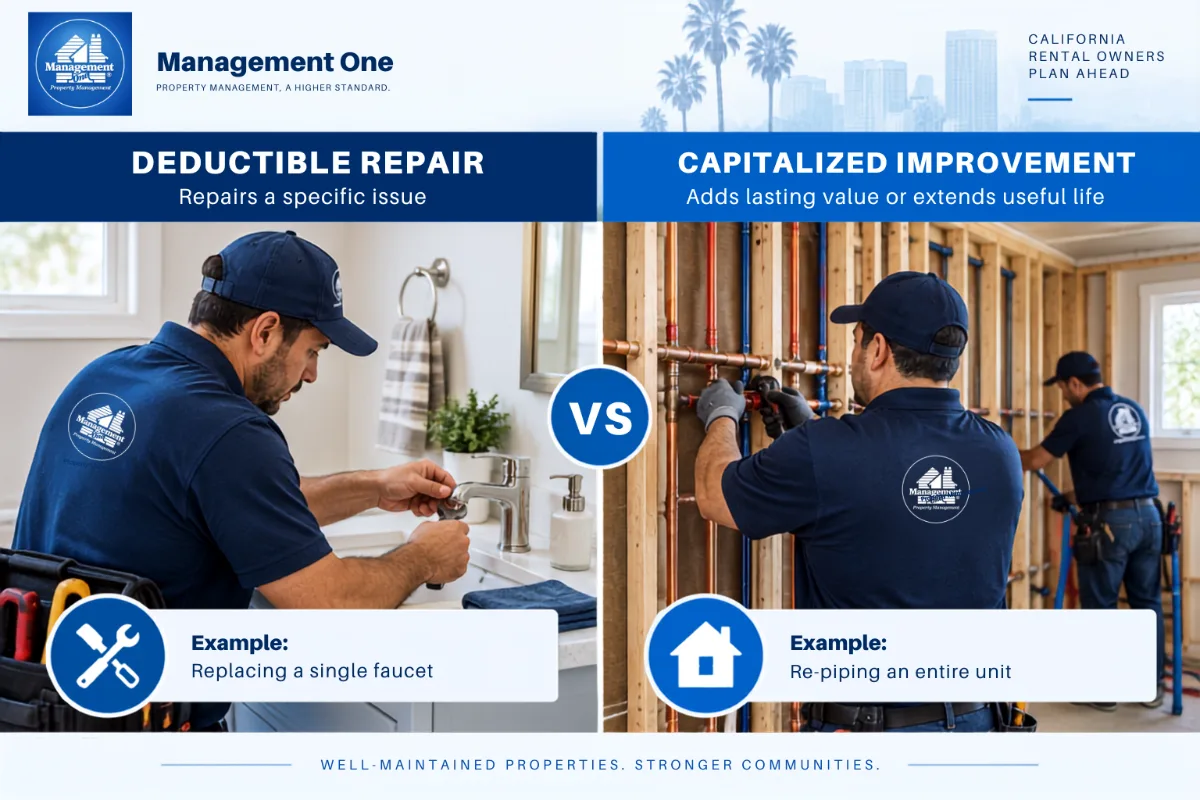
This is where the real money is, and the IRS tangible property regulations set the line. A repair keeps the property in the condition it was already in. A capital improvement betters it, restores it, or adapts it to a new use - and gets capitalized and depreciated instead of deducted now.
Concrete local examples:
- Repainting a unit between tenants in Corona is a repair - deduct it now. Re-roofing that same house restores a major building system and gets capitalized.
- Replacing a leaking faucet is a repair. Re-piping the whole unit because 1970s galvanized supply lines finally gave out is an improvement.
- Servicing the AC before an Inland Empire summer is maintenance. Replacing the entire HVAC system is an improvement.
- Patching a section of stucco is a repair. Adding a permitted ADU or converting the garage is an improvement, full stop.
- Replacing a few broken pavers is a repair. Tearing out the lawn for a drought-tolerant redesign leans improvement.
Misclassifying a $14,000 re-roof as a repair is a common audit flag. Misclassifying a $400 faucet as an improvement means waiting 27.5 years for a deduction you could have taken in December. Weighing a larger project? Our guide to remodeling a rental property covers which upgrades actually pay back.
Two safe harbors that can move costs into "deduct now"
The tangible property regulations include elections that let smaller owners deduct costs that would otherwise be capitalized:
The de minimis safe harbor. Without an applicable financial statement, you may elect to deduct amounts up to $2,500 per invoice or per item rather than capitalizing them; owners who have one get $5,000. It is an annual election made by attaching a statement to a timely filed return - not automatic.
The safe harbor for small taxpayers. If your average annual gross receipts are $10 million or less, the building's unadjusted basis is $1 million or less, and your total spend on repairs, maintenance and improvements for that building that year does not exceed the lesser of 2% of unadjusted basis or $10,000, you can elect out of the improvement rules for that building and deduct the lot.
That second one is genuinely useful for a single rental - with a hard edge: blow through the threshold in December and you lose the election for the whole year.
Safe harbors run per invoice and per item. A contractor who bills one line for "unit turn - $6,800" gives you nothing to work with. The same work itemized into paint, faucet, blinds and cleaning may sit under the de minimis threshold. Ask for the breakdown up front.
Passive losses and the $25,000 special allowance
Rental losses are generally passive, meaning they offset passive income rather than your W-2 wages. The main federal exception: if you actively participate - approving tenants, setting rent terms, authorizing repairs - you may deduct up to $25,000 of rental loss against non-passive income.
That allowance phases out fast. It is reduced by 50% of the amount your modified adjusted gross income exceeds $100,000, and is gone entirely at $150,000 (half those figures for married filing separately). Disallowed losses carry forward. IRS Publication 925 has the full mechanics. Remember the California overlay: clearing the federal hurdle does not change the state's passive treatment.
The 20% qualified business income deduction
Rental owners may also be eligible for the Section 199A qualified business income deduction - up to 20% of qualified business income - if the rental rises to the level of a trade or business. Revenue Procedure 2019-38 offers a safe harbor for treating a rental real estate enterprise as a trade or business, and it is demanding: at least 250 hours of rental services per year, separate books and records, and contemporaneous logs of hours, dates and who did the work. Triple-net leases are excluded.
Failing the safe harbor does not automatically disqualify you - a rental can still be a trade or business under the general standard. But the documentation has to be built during the year, not reconstructed in April. How 199A applies to you for 2026 is a question for your CPA.

Your before-December-31 action list
Most individual owners are cash-basis taxpayers: you deduct what you actually pay by December 31. That makes Q4 your only window.
- Finish the deferred repairs. Every punch-list item you have put off becomes this year's deduction if the work is done and paid by December 31. A standing rental property maintenance checklist turns this into a 20-minute review instead of a guess.
- Pay the invoice, do not just approve it. Cash basis means the check has to clear the year. Chase vendors for December invoices now.
- Place new assets in service. An appliance sitting in the garage on December 31 is not in service. Install it.
- Prepay where the expense is genuinely incurred. January landscaping or an insurance renewal may be payable in December. There are limits - your CPA knows where the line is.
- Reconcile the mileage log. The IRS standard mileage rate changed mid-year in 2026 - 72.5 cents per mile January through June, then 76 cents - so your log needs dates, not just a total.
- Ask for itemized invoices on anything you want to run through a safe harbor.
- Total your repair spend per building before approving another project, so you know whether the small-taxpayer safe harbor is still in reach.
- Decide big projects now, not in March. A full turn completed in December is deductible this year instead of next.
- Pull the year-end owner statement and reconcile it while the details are fresh.
- Book the CPA conversation for December, not April. Once the year closes, your options close with it.
Before you spend, ask your CPA: "Is this deduction worth more to me this year or next?" If your income is unusually high in 2026, accelerating repairs makes sense. If 2027 looks like the bigger year, deferring a non-urgent project may be worth more.
Records: what you want in a folder in January
Every deduction is only as strong as your ability to prove it. Keep a separate bank account for the rental, invoices detailed enough to show what was done, the mileage log, both depreciation schedules, and the closing statement from the day you bought - it is the foundation of your basis and you will need it when you sell.
Owners who work with a professional manager get most of this without effort: monthly statements, categorized expenses, vendor invoices stored against the property, and a year-end summary that maps to Schedule E lines. That matters as much in Orange County property management as it does in Riverside property management.
The bottom line
Rental property tax deductions are the quiet engine of rental returns in California - and the state's non-conformity on bonus depreciation, its lower Section 179 cap and its blanket passive treatment mean the federal answer is only half the answer here. Get the repairs-versus-improvements line right, claim the depreciation you are entitled to, keep records an auditor could follow, and use the weeks before December 31 deliberately. Then hand it to a CPA who knows California rentals.
Management One has helped Southern California owners run profitable, well-documented rentals for decades - with the itemized statements, vendor records and year-end reporting that turn tax season into a copy-and-paste job. Reach out for a no-pressure conversation about your property.
Frequently Asked Questions
What can I deduct on a rental property?
Almost every ordinary and necessary cost of operating the rental: mortgage interest, property taxes, insurance, repairs and maintenance, management fees, leasing and advertising, utilities you pay, HOA dues, legal and tax-prep fees, travel to the property, and depreciation on the building. Capital improvements are also deductible, but spread over years instead of all at once.
Is rental income taxable in California?
Yes. Your net rental profit is reported federally on Schedule E, flows into your adjusted gross income, and is then taxed by California as ordinary income at the state's graduated rates. California residents are taxed on rental income from property anywhere; nonresidents are taxed on income from California property.
How does rental property depreciation work?
For residential rental property, the IRS lets you recover the cost of the building - never the land - using straight-line depreciation over 27.5 years under the General Depreciation System, with a mid-month convention. Depreciation is not optional in practice: the IRS reduces your basis by the depreciation you were allowed to take whether or not you claimed it.
What is the difference between a repair and a capital improvement?
A repair keeps the property in the condition it was already in and is deductible in the year you pay it. A capital improvement betters the property, restores it, or adapts it to a new use, and has to be capitalized and depreciated. Repainting a unit between tenants is a repair; replacing the entire roof is an improvement.
Can I deduct a rental loss against my regular income?
Sometimes. Federally, if you actively participate, you may deduct up to $25,000 of rental loss against non-passive income. That allowance is reduced by 50 cents for every dollar of modified adjusted gross income over $100,000 and disappears entirely at $150,000. Disallowed losses carry forward.
Does California follow federal bonus depreciation rules?
No. California does not conform to the federal additional first-year (bonus) depreciation under IRC Section 168(k). That means an appliance or improvement you write off immediately on your federal return may still have to be depreciated over its normal life for California, creating a separate state depreciation schedule reported on Form FTB 3885A.
Are property management fees tax deductible?
Yes. Management fees are an ordinary and necessary operating expense of a rental and are generally fully deductible on Schedule E in the year you pay them, alongside leasing fees, maintenance coordination and other professional services.
What should I do before December 31 to lower my rental tax bill?
Complete and pay for deferred repairs, pay January bills in December where the expense is genuinely incurred, place any new appliance or flooring in service before year-end, settle outstanding vendor invoices, log your mileage, and get every receipt categorized. A cash-basis owner deducts what is actually paid by December 31.


Related Posts