
The California Eviction Process: Step-by-Step Guide for Landlords

Evicting a tenant is the part of being a landlord no one enjoys - and the part where mistakes are most expensive. California has some of the most tenant-protective rules in the country, and the California eviction process (formally called an "unlawful detainer") must be followed exactly. Skip a step or use the wrong notice, and a judge can dismiss your case and send you back to the start weeks later. This guide walks Inland Empire landlords through the process as it stands in 2026.
Step 1: Confirm you have a valid, legal reason
Before anything else, make sure you have grounds. Under the statewide Tenant Protection Act (AB 1482), most tenants who have occupied a unit for at least 12 months are covered by "just cause" protections. That means you generally need either an at-fault reason (nonpayment of rent, a lease violation, illegal activity) or a no-fault reason (owner move-in, withdrawal from the rental market, a substantial remodel). No-fault removals usually require paying the tenant one month's rent in relocation assistance. Check current local rules too, since some cities layer on additional protections.
Step 2: Serve the correct California eviction notice
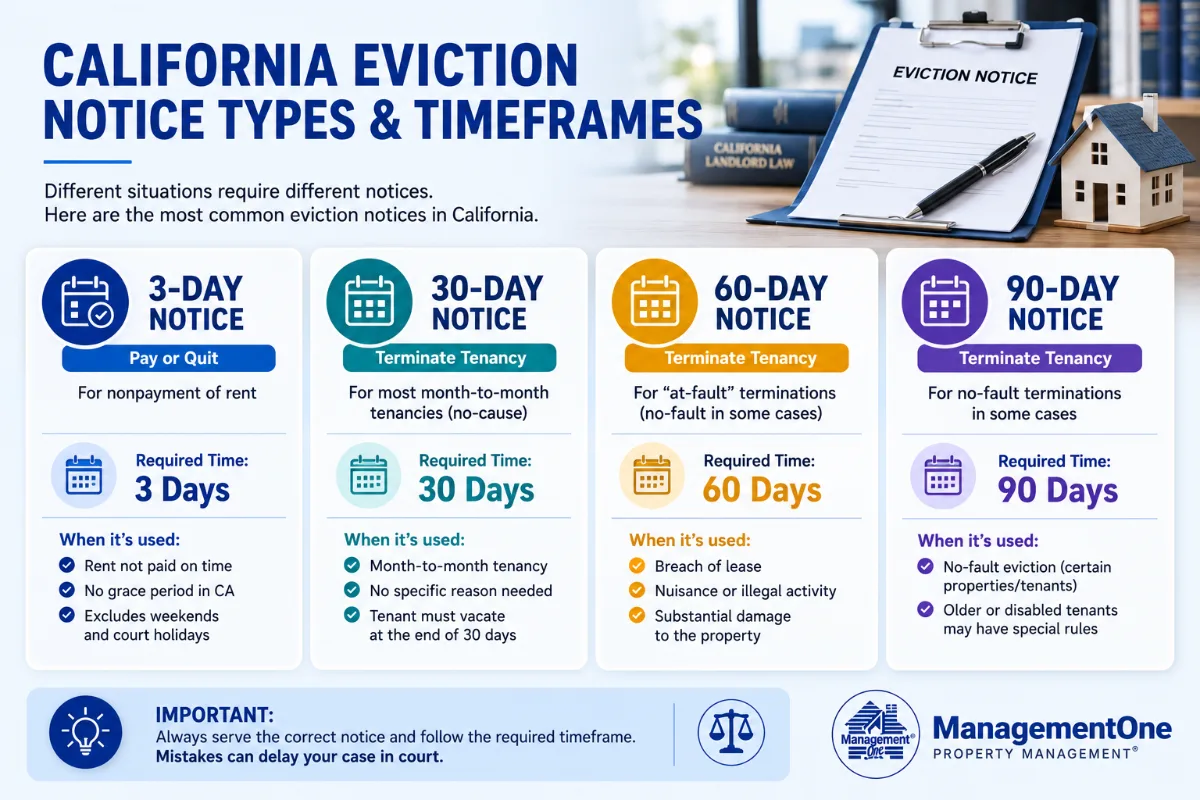
The right California eviction notice depends on the reason:
- 3-day notice to pay rent or quit - for unpaid rent. The 3 days exclude weekends and holidays, and you may only demand past-due rent, not late fees.
- 3-day notice to cure or quit - for a fixable lease violation, giving the tenant a chance to correct it.
- 3-day notice to quit - for serious issues like illegal activity, with no cure option.
- 30-day notice - to end a month-to-month tenancy of less than one year (where just-cause rules allow).
- 60-day notice - to end a tenancy of one year or more.
- 90-day notice - generally required for Section 8 and certain subsidized tenancies.
Serve the notice properly - personal delivery, substituted service, or posting and mailing - and keep a proof of service. An incorrectly served or miscalculated notice is the number-one reason cases get thrown out.
Step 3: File the unlawful detainer lawsuit
If the tenant does not pay, cure, or move out by the deadline, you file an unlawful detainer complaint with the Riverside County Superior Court and pay the filing fee. The tenant is then served with a summons and complaint. As of 2025, tenants have 10 business days to file a written response - an extension from the prior 5-day window - so build that into your expectations for the eviction process timeline California now follows.
Step 4: The court hearing and judgment
If the tenant does not respond in time, you can request a default judgment. If they do respond, the court sets a trial - usually within about 20 days of the request. At trial, both sides present evidence: the lease, ledgers, notices, and proof of service. Organized documentation wins these cases. If the judge rules in your favor, the court issues a judgment for possession.
Step 5: The sheriff's lockout
Only the county sheriff can physically remove a tenant. After judgment, you request a "writ of possession," the sheriff posts a 5-day notice to vacate, and if the tenant has not left, the sheriff performs the lockout. At no point may you change the locks, remove belongings, or shut off utilities yourself - those "self-help" evictions are illegal and can cost you far more than the eviction itself. The California Courts Self-Help Center publishes the official forms and step-by-step instructions.
How long does an eviction take in California?
Owners always ask how long does an eviction take in California, and the honest answer is: it depends on whether the tenant fights it. An uncontested case typically runs 30 to 45 days from notice to lockout. A contested case, or one slowed by court backlogs, can stretch to two or three months. The fastest cases are the ones where the paperwork was flawless from day one.
Common landlord mistakes that restart the clock
- Miscalculating the notice period or demanding the wrong amount.
- Accepting partial rent after serving a pay-or-quit notice, which can waive it.
- Using a generic notice that ignores just-cause requirements.
- Attempting a self-help lockout out of frustration.
If you would rather never navigate an unlawful detainer alone, our Riverside property management team handles notices, documentation, and attorney coordination for Inland Empire owners - correctly, the first time.
Frequently Asked Questions
How long does an eviction take in California?
Most uncontested unlawful detainer cases run 30 to 45 days from serving the notice to a lockout by the sheriff. Contested cases, or those delayed by the required notice period and court backlogs in Riverside County, can take two to three months or longer.
Can I change the locks or shut off utilities to remove a tenant?
No. 'Self-help' evictions - changing locks, removing belongings, or cutting off power or water - are illegal in California and expose you to significant tenant damages. Only the county sheriff can remove a tenant, and only after a court judgment.
What notice do I give a tenant who has not paid rent?
A 3-day notice to pay rent or quit. The 3 days exclude weekends and court holidays, and the amount demanded must be accurate - only past-due rent, not late fees or other charges.
Do I need 'just cause' to evict in California?
Often, yes. Under the statewide Tenant Protection Act, most tenants who have lived in a unit for 12 months are protected by just-cause rules, which limit the reasons you can end a tenancy and may require relocation assistance for no-fault removals.
Can I evict a tenant myself without an attorney?
You can, but unlawful detainer is technical and a single paperwork error can restart the case. Given the stakes, most owners use a qualified eviction attorney or a professional manager who coordinates one.



Related Posts