
Can a California Landlord Deny an Emotional Support Animal? Service Animals vs. ESAs Explained

Few requests put California landlords in a tighter spot than a tenant asking to keep an emotional support animal in a “no pets” rental. Say yes without understanding the rules, and you may forfeit legitimate protections; say no, and you risk a fair housing complaint that can cost you far more than any pet deposit. The confusion is understandable – service animals and emotional support animals sound similar but carry different rights, and California layers its own documentation rules on top of federal law. This 2026 guide explains exactly when a California landlord can and cannot deny an ESA, how ESAs differ from service animals, and what valid documentation actually looks like.
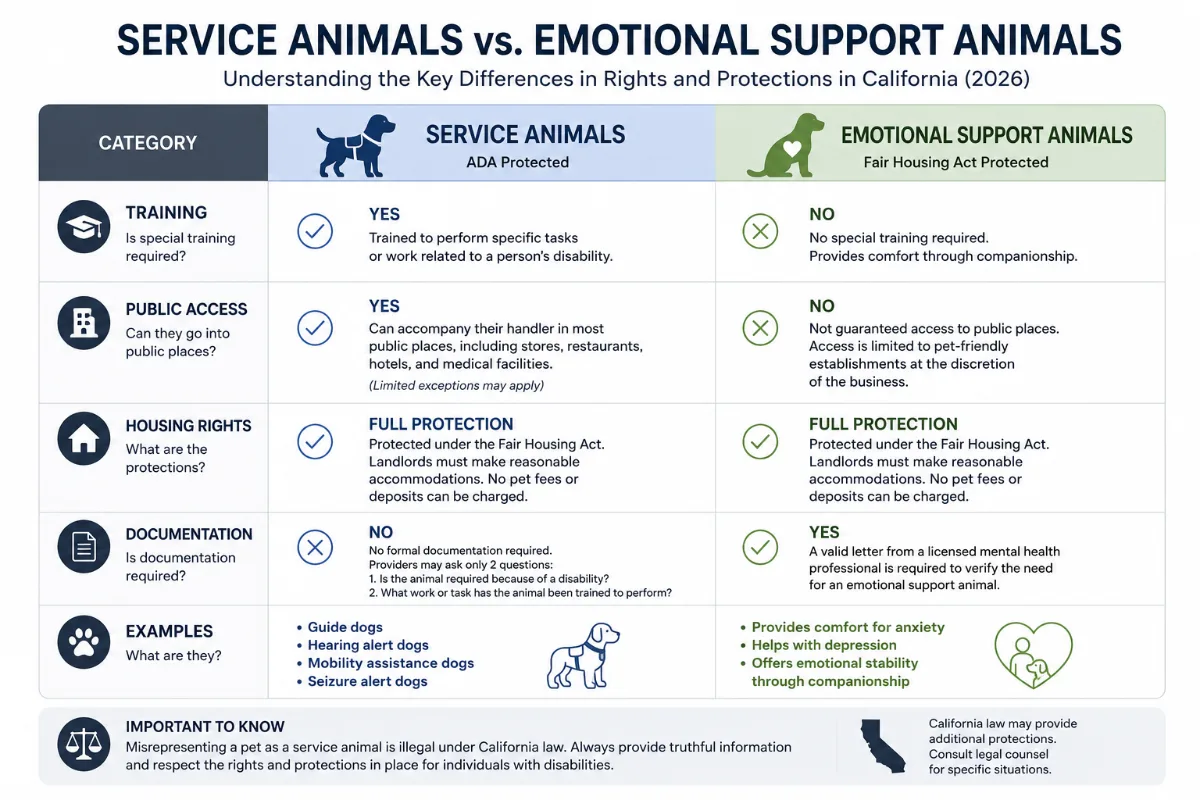
Service animal vs. emotional support animal: the core difference
These two terms get used interchangeably, but the law treats them differently.
- A service animal is a dog (and, in limited cases, a miniature horse) that has been individually trained to perform specific tasks for a person with a disability – guiding someone who is blind, alerting to a seizure, or retrieving items, for example. Service animals have broad access rights, including to most public places.
- An emotional support animal (ESA) provides therapeutic benefit through its presence – easing anxiety, depression, or PTSD – but is not individually trained to perform tasks. ESAs do not have the same public-access rights as service animals.
💡
It’s an Accommodation, Not a Pet
Here’s the key point for owners: in the housing context, both service animals and emotional support animals are treated as assistance animals, not pets. Federal fair housing law and California’s FEHA require landlords to reasonably accommodate them, even when the property has a “no pets” policy.
Because an ESA or service animal is a reasonable accommodation, your normal pet rules – breed restrictions, pet deposits, pet rent, weight limits – generally do not apply. Treating an assistance-animal request as a routine “pet request” is one of the most common and costly mistakes California owners make.
So, can a California landlord ever deny an ESA?
Yes, but only in narrow circumstances. Assuming the tenant has a disability and a disability-related need for the animal, backed by valid documentation, a landlord generally must accommodate. You may lawfully deny or limit the request only in specific situations, including when:
- The specific animal would pose a direct threat to the health or safety of others that can’t be reduced by another accommodation (based on that animal’s actual conduct, not breed or size stereotypes).
- The animal would cause substantial physical damage to property that cannot be reduced.
- The accommodation would impose an undue financial or administrative burden or fundamentally alter the nature of your operation – a high bar that rarely applies to a single rental home.
- The request is based on fraudulent or invalid documentation (more on that below).
What you cannot do is deny because the property is “no pets,” because you’d prefer a deposit, or because you’re skeptical of ESAs in general. For a broader look at where owner authority ends, our overview of what a landlord cannot do in California is a useful companion.
What valid ESA documentation looks like in California
California tightened the rules on ESA documentation to curb online “instant certificate” mills. Under AB 468, a health care practitioner who signs documentation establishing a tenant’s need for an emotional support animal must have an established provider-client relationship with that person for at least 30 days before providing the documentation, and must be appropriately licensed. A same-day certificate bought from a website generally does not meet this standard.
For you as the landlord, a valid ESA request typically includes a letter from a licensed provider confirming that the tenant has a disability and that the animal helps with that disability. Importantly:
- You may ask for reliable documentation of the disability-related need if the disability isn’t obvious.
- You may not demand the tenant’s specific diagnosis or detailed medical records.
- You may not require special ESA “certifications,” registrations, or ID cards – those aren’t legally recognized.
⚠️
Fees and Deposits: Know the Line
You cannot charge a pet deposit, pet fee, or pet rent for an assistance animal. You can hold the tenant responsible for actual damage the animal causes beyond normal wear, documented and handled like any other damage claim at move-out. Charging a “pet” fee for an ESA is a frequent trigger for fair housing complaints.
How to handle an ESA request the right way
 When a tenant makes a request, respond promptly and in good faith. A clean process protects you:
- Treat it as a reasonable-accommodation request, even if the tenant doesn’t use that exact phrase.
- Request appropriate documentation only if the disability or need isn’t obvious – and only what the law allows.
- Engage in the interactive process. If something’s unclear, communicate; don’t just deny.
- Document every step – the request, what you asked for, what was provided, and your decision.
- Apply damage rules, not pet rules, and note any concerns about the specific animal’s actual behavior.
Because insurance carriers sometimes raise breed or animal questions, it’s worth coordinating this with your coverage – our post on service animals, ESAs, and insurance digs into how policies and assistance-animal obligations intersect.
A note on getting it wrong
Fair housing violations are expensive. Wrongly denying a legitimate ESA, charging pet fees for an assistance animal, or demanding a diagnosis can lead to complaints, penalties, and legal costs that dwarf any inconvenience of accommodating the animal. When a request is genuine and properly documented, accommodating it is almost always both the legal and the smart business choice.
This article is a plain-English overview, not legal advice. Assistance-animal cases are fact-specific, and the law changes, so consult a qualified attorney or talk to our team before denying a request or issuing a notice.
🚀
Unsure How to Handle an ESA Request?
Management One helps Inland Empire and Orange County owners handle assistance-animal requests, documentation, and fair housing compliance the right way, protecting both your property and your peace of mind.
Frequently Asked Questions
Can a landlord deny an emotional support animal in California?
In most cases, no, not if the tenant has a disability and provides valid documentation of their need for the animal. Under fair housing law, an ESA is treated as a reasonable accommodation, not a pet. A landlord may deny only in narrow situations, such as a direct threat to safety, undue financial burden, or fraudulent documentation.
What’s the difference between a service animal and an ESA?
A service animal is a dog (or in some cases a miniature horse) individually trained to perform tasks for a person with a disability, with broad access rights. An emotional support animal provides comfort by its presence but is not task-trained. For housing, both must be reasonably accommodated – but ESAs do not get the same public-access rights as service animals.
Can a landlord charge a pet deposit or pet rent for an ESA in California?
No. Because a service animal or ESA is an accommodation and not a pet, a landlord cannot charge a pet deposit, pet rent, or pet fee for it. The tenant can, however, be held responsible for actual damage the animal causes, just like any other property damage.
Is this article legal advice?
No. This is a plain-English overview of California and federal assistance animal rules. These situations are fact-specific, and the law changes, so consult a qualified attorney or talk to our team before denying a request or issuing a notice.



Related Posts