
California Rent Increase Law for 2027: AB 1482’s Annual Cap and the 90-Day Notice Inland Empire Owners Need to Send Now

Why October Is the Month Inland Empire Owners Should Be Thinking About January Rent
If you manage rental property anywhere in Riverside County, Corona, or the broader Inland Empire, the rent increase you want to put in place for January 1 is not a January decision. It is an October decision. California's rent increase law under AB 1482, the Tenant Protection Act of 2019, puts a statewide cap on most annual increases and layers a notice requirement on top of it that can run as long as 90 days. Get the timing wrong and your January increase effectively becomes a March or April increase instead, because the notice period has to run its full course before the new rent is enforceable.
This post walks through exactly how the AB 1482 cap works, how the required notice period is calculated under California law, which properties are exempt, and why now, not December, is when the paperwork needs to start.
AB 1482 covers most multifamily rentals and many single-family rentals in California that are not otherwise exempt, as outlined in official state resources including the California Department of Housing and Community Development, Tenant Protection Act guidance. If you are unsure whether your property qualifies as exempt, treat it as covered until you have confirmed otherwise in writing with your lease documentation.
The AB 1482 Rent Cap Formula, Explained Simply
California's statewide rent cap is set out in Civil Code Section 1947.12 (AB 1482 rent cap). The rule itself is straightforward even though the number behind it moves every year: a covered unit's rent cannot increase, in any rolling 12-month period, by more than the lesser of:
- 10 percent, or
- 5 percent plus the percentage change in the applicable regional Consumer Price Index (CPI)
Whichever of those two numbers is smaller is the number that actually governs your increase. In high-inflation years, the 10 percent ceiling often ends up being the binding limit. In lower-inflation years, the CPI-based formula can land well under 10 percent, sometimes in the 3 to 6 percent range depending on the region.
For Inland Empire owners, the relevant CPI figure is the one published for your property's metro region (the Riverside-San Bernardino-Ontario area, for most Management One clients), not a single statewide number. That regional figure is recalculated annually from April CPI data, and the updated percentage generally takes effect for increases on or after August 1, not January 1. So while plenty of owners structure their lease renewals and increases around the calendar year for simplicity, the cap percentage itself runs on its own CPI-driven calendar, and the exact figure for any given window should be confirmed before you finalize a notice amount.
Because the allowable percentage changes with each CPI release, do not rely on last year's number. Confirm the current regional figure with your property management team or a local apartment association before calculating a specific dollar increase, and keep documentation of the CPI source you used.
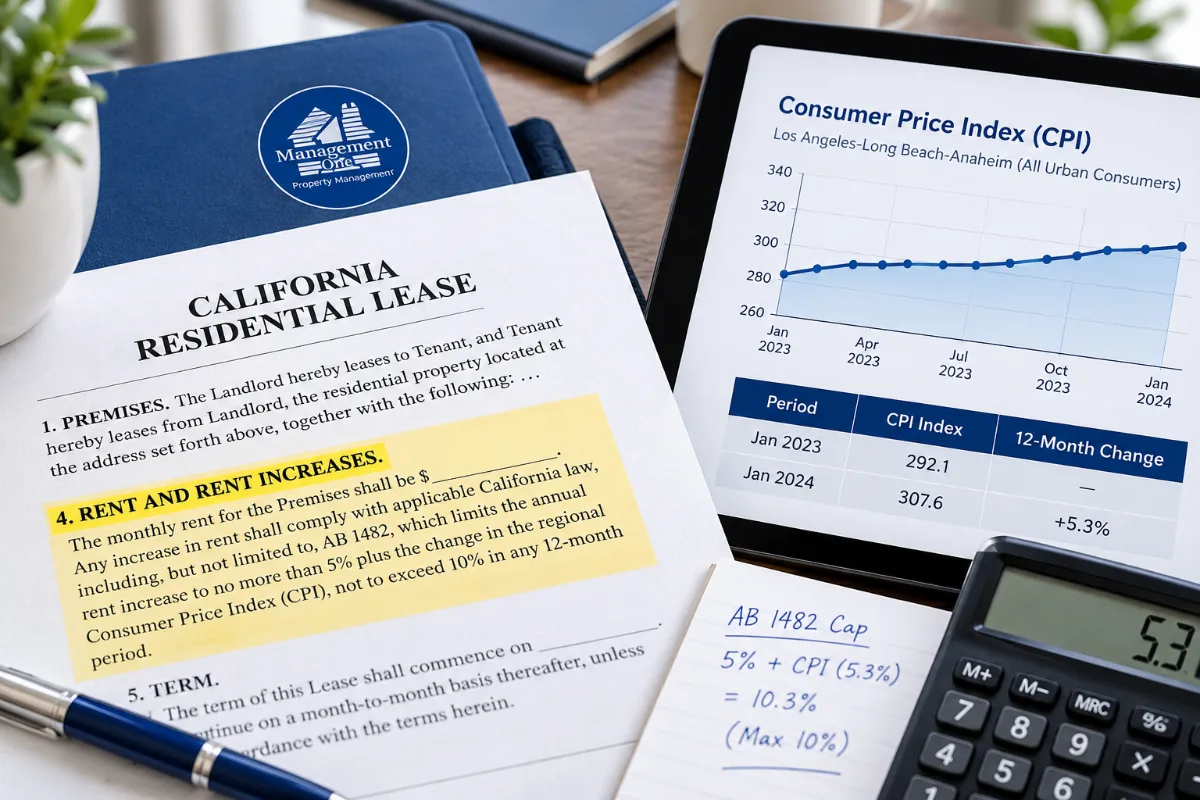
Side-by-side of a California lease rent clause and a Consumer Price Index chart used to calculate the AB 1482 annual cap
The 90-Day Notice Rule: Why Size of the Increase Changes Your Timeline
This is the piece that catches owners off guard every year. Under Civil Code Section 827 (rent increase notice periods), the amount of advance notice you owe a tenant depends on how large the increase is relative to what they have paid over the prior 12 months:
- 10 percent or less: 30 days written notice
- More than 10 percent (cumulative over the trailing 12 months): 90 days written notice
The 90-day trigger is not just about a single increase. It is cumulative. If you already raised rent earlier in the year and this new increase would push the combined total above 10 percent of what the tenant paid 12 months ago, you owe 90 days notice on this increase too, even if the new increase by itself looks modest.
There is a narrow exception: increases tied to a required income recertification under certain subsidized housing programs can still use a 30-day notice even when the increase exceeds 10 percent. For nearly all market-rate Inland Empire rentals, though, the general rule above is what applies.
If you want a rent increase in effect on January 1 and that increase is more than 10 percent of the rent charged a year earlier, 90 days before January 1 lands in early October. That is the entire reason this topic belongs on an October task list, not a December one.
Exemptions: Single-Family Homes, New Construction, and What Still Applies Even When the Cap Doesn't
Not every rental is subject to the AB 1482 cap, but the exemptions are narrower than many owners assume.
Single-family homes and condominiums. These can be exempt from both the rent cap and statutory tenant protections under Civil Code Section 1946.2 (just cause eviction), but only when the owner is a natural person (or a qualifying trust or estate), not a real estate investment trust, corporation, or an LLC with any corporate member. Just as important, the lease must include the specific statutory disclosure notifying the tenant that the property is exempt. Without that disclosure in the lease, many owners who would otherwise qualify for the exemption lose it, and the cap applies by default.
New construction. Properties with a certificate of occupancy issued within the last 15 years are exempt from the rent cap. This is a rolling window, which means a property that qualified as exempt new construction a few years ago can age into coverage under the cap as that 15-year mark passes. It is worth checking the certificate of occupancy date against the calendar each year rather than assuming last year's exemption status still holds.
Even when a property is exempt from the percentage cap itself, normal notice requirements under Civil Code Section 827 still apply to any rent increase, and local rent control ordinances that predate AB 1482 or that are stricter than the state cap are not preempted. Most cities across Riverside County and Corona currently operate under the state standard without an additional local cap, but ordinances can change, so this is worth a quick confirmation before finalizing notices each year.
If you are treating a property as exempt, keep the ownership structure documentation and the lease disclosure language on file. Failing to execute clear, formal leases can create severe tenancy disputes—and in worst-case scenarios, navigating ambiguous occupancy claims or squatters' rights in California becomes an expensive legal battle. An exemption claim without the paperwork to back it up is an avoidable risk.
A Practical October-to-January Timeline
For owners aiming at a January 1 effective date, here is roughly how the math works backward:
- Early October: Confirm this year's regional CPI figure and calculate the maximum allowable increase for each unit. Determine whether any planned increase exceeds 10 percent cumulative over the trailing 12 months.
- By the first week of October: Serve 90-day notices for any increase above the 10 percent threshold, so the notice period concludes before January 1.
- Through November and December: Serve 30-day notices for smaller increases, since those have more flexibility on timing.
- January 1: New rents take effect, assuming notices were served correctly and on time.
This is also a natural point in the year to review which units might be approaching the 15-year new-construction exemption cutoff, and to make sure exempt single-family leases still carry the required disclosure language before they renew.
Tracking CPI updates, notice periods, and exemption documentation across a portfolio is exactly the kind of recurring compliance work our team handles every year for rental owners. Whether you operate in Riverside County or need regional expertise like Orange County property management, our professionals protect your margins while keeping you compliant. If you would rather hand off the rent increase calendar than build it yourself, reach out to Management One.
This article provides general information about California rent increase law and is not legal advice. Statutory caps, CPI figures, and notice requirements can change, and local ordinances vary by city. Confirm current figures and specific lease language with a California real estate attorney or your property manager before serving a rent increase notice. Statutory references in this article are current as of October 2026.
Frequently Asked Questions
How much can a landlord raise rent in California in 2027?
Under AB 1482, most covered rental units are limited to the lesser of 10 percent or 5 percent plus the change in the regional Consumer Price Index, applied to the lowest rent charged for that unit in the prior 12 months. The exact percentage depends on your property's region and the effective date of the increase, since the figure is recalculated each year from new CPI data. Owners of exempt single-family homes and condos (with the required lease disclosure) and buildings with a certificate of occupancy issued in the last 15 years are not bound by this cap, though they still owe normal notice periods.
Does the AB 1482 rent cap reset on January 1 every year?
Not exactly. The allowable percentage is recalculated using April Consumer Price Index data and the new figure generally takes effect for increases on or after August 1 each year, not January 1. Many owners still choose to implement their annual increase at the start of the calendar year for lease administration simplicity, which is why the 90-day notice countdown for a January 1 increase matters so much in October.
When does a rent increase require 90 days notice instead of 30 days in California?
Civil Code Section 827 requires 90 days written notice whenever a rent increase, combined with any other increases in the trailing 12 months, is more than 10 percent of the lowest rent charged during that period. An increase of 10 percent or less only requires 30 days notice. There is a narrower exception allowing 30 days notice for increases tied to income recertification in subsidized housing programs, even if the increase exceeds 10 percent.
Are single-family homes exempt from California's rent increase cap?
Single-family homes and condominiums can be exempt from the AB 1482 cap and just cause eviction rules, but only if the owner is not a real estate investment trust, a corporation, or an LLC with a corporate member, and only if the lease includes the specific statutory disclosure notifying the tenant of the exemption. Skipping that disclosure language is one of the most common compliance mistakes we see, and it can mean the cap applies anyway.
Can an Inland Empire city have stricter rent control than AB 1482?
Yes. AB 1482 sets a statewide floor, but it does not override a local rent control ordinance that was already in effect before AB 1482 passed in 2019 or that is stricter than the state cap. Most Riverside County and Corona-area cities currently follow the state cap without an additional local ordinance, but owners should always confirm current city rules before finalizing a notice, since local rules can change.
What happens if I send a rent increase notice without enough lead time?
A notice that does not give the required 30 or 90 days falls short of Civil Code Section 827, and the increase typically is not enforceable on the date you intended. Tenants can treat the old rent as controlling until a properly timed notice is served, which can cost an owner months of the intended increase. That is exactly why Inland Empire owners should calculate the required notice window well before their target effective date.



Related Posts