
Inland Empire Map: City by City
The cities of the western Inland Empire, across Riverside and San Bernardino Counties, grouped by region with the rental market in each one. Property owners: the cities we manage are linked through to their local market page.
The Inland Empire, City by City
Pan and zoom the map. Blue markers are cities Management One manages. Click one for its local rental market page. Every other city shown sits across the western Inland Empire; click any of them to ask about your property.
Maps of the Inland Empire
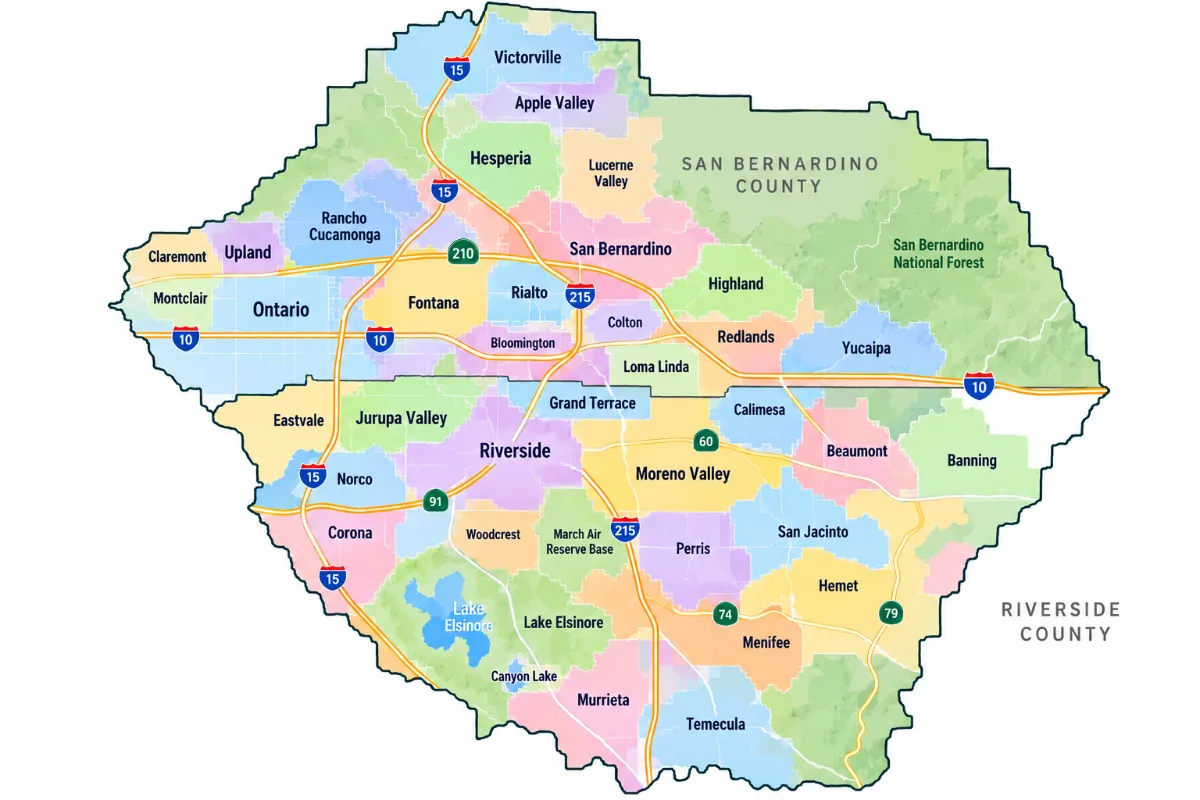
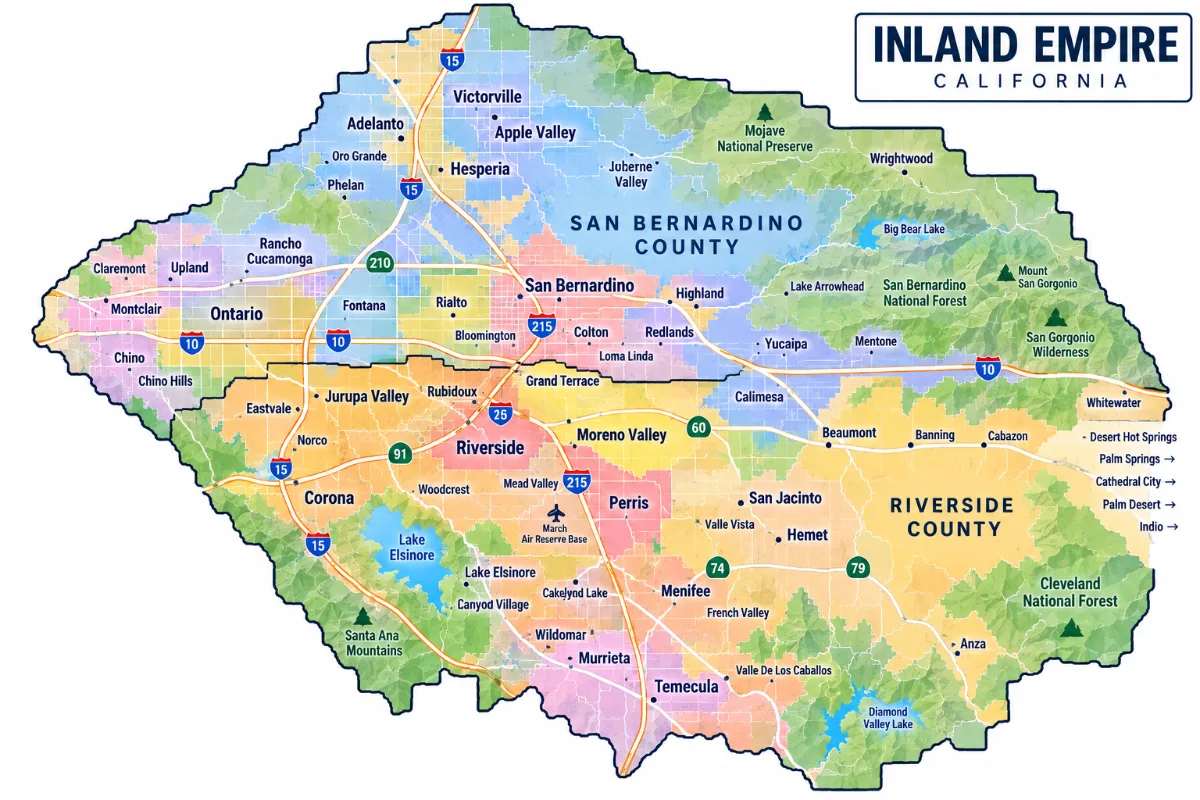
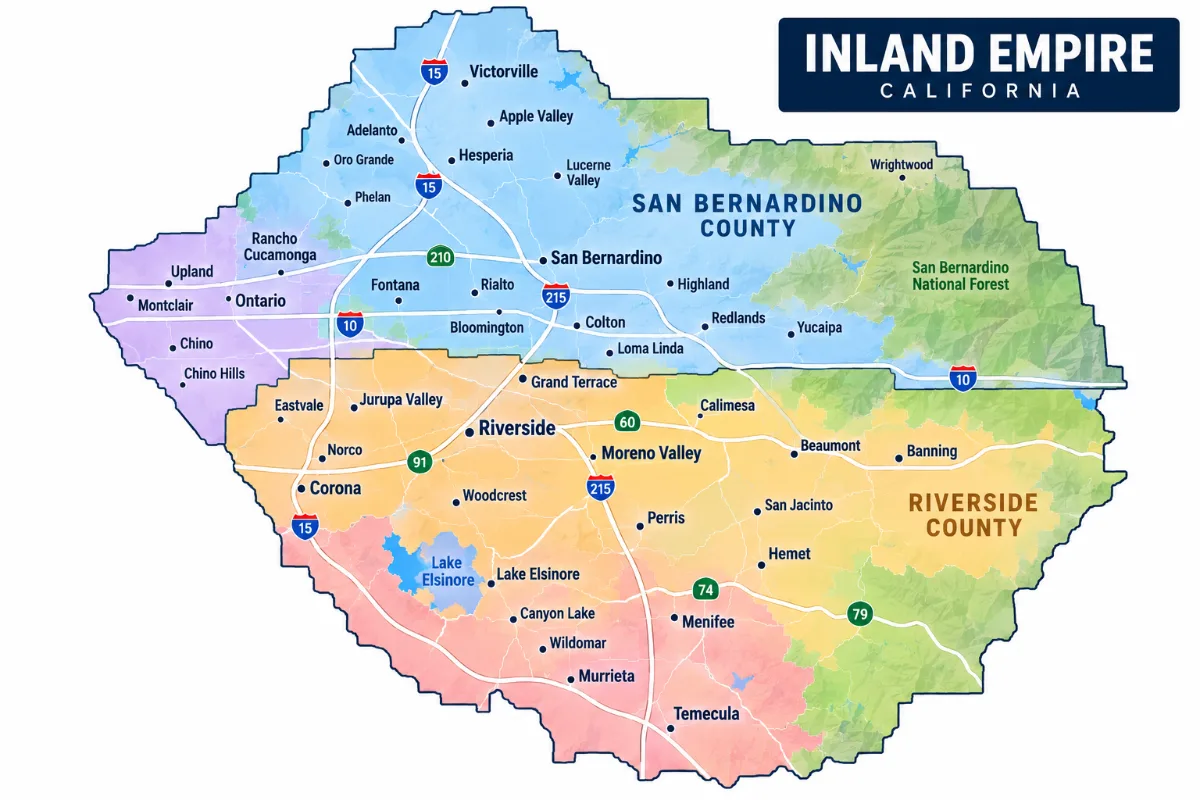
Three printable maps of the Inland Empire, California: its two counties, cities, freeways and natural features. Click any map to open it full size.
Western Inland Empire Cities, by Region
The Inland Empire spans two counties. The populated western corridor, where rental demand concentrates, splits into four working areas. Price points, commute patterns and the type of property owner differ across them.
Riverside County · West
5 of 7 managedRiverside County · Southwest
4 of 8 managedSan Bernardino County · West Valley
6 of 8 managedSan Bernardino County · Valley
0 of 7 managedWhere the Inland Empire Sits in California
The Inland Empire is the inland metro region of Southern California, made up of Riverside County to the south and San Bernardino County to the north. It begins where Los Angeles and Orange Counties end, east of the Chino Hills and the Santa Ana Mountains, and runs east toward the high desert.
Together the two counties held a population of 4,599,839 as of the 2020 Census across 52 incorporated cities. San Bernardino is the largest county in the United States by area, though most of its residents, and nearly all of its rental housing, sit in the western valley cities shown on this map.
San Bernardino is the seat of San Bernardino County, and Riverside is the seat of Riverside County and the largest city in the region. The western corridor along the 10, 15, 60 and 215 freeways is where rental demand concentrates, from Chino Hills and Ontario in the west to Redlands and Yucaipa in the east, and south through Corona, Temecula and Murrieta.
For a rental property owner, the practical divide is west valley versus inland valley. A three-bedroom home in Chino Hills and the same home in Perris or Hemet sit at different ends of the Inland Empire rent range, and they attract different residents, different lease lengths and different maintenance profiles.
Inland Empire Population by City
The western Inland Empire cities shown above, ranked by 2020 Census population. The cities Management One manages are linked to their local rental market page.
| # | City | 2020 Population | County |
|---|---|---|---|
| 1 | Riverside | 314,998 | Riverside County |
| 2 | San Bernardino | 222,101 | San Bernardino County |
| 3 | Moreno Valley | 208,634 | Riverside County |
| 4 | Fontana | 208,393 | San Bernardino County |
| 5 | Ontario | 175,265 | San Bernardino County |
| 6 | Rancho Cucamonga | 174,453 | San Bernardino County |
| 7 | Corona | 157,136 | Riverside County |
| 8 | Murrieta | 110,949 | Riverside County |
| 9 | Temecula | 110,003 | Riverside County |
| 10 | Jurupa Valley | 105,053 | Riverside County |
| 11 | Rialto | 104,026 | San Bernardino County |
| 12 | Menifee | 102,527 | Riverside County |
| 13 | Chino | 91,403 | San Bernardino County |
| 14 | Hemet | 89,833 | Riverside County |
| 15 | Upland | 79,040 | San Bernardino County |
| 16 | Perris | 78,700 | Riverside County |
| 17 | Chino Hills | 78,411 | San Bernardino County |
| 18 | Redlands | 73,168 | San Bernardino County |
| 19 | Lake Elsinore | 70,265 | Riverside County |
| 20 | Eastvale | 69,757 | Riverside County |
| 21 | Highland | 56,999 | San Bernardino County |
| 22 | Yucaipa | 54,542 | San Bernardino County |
| 23 | Colton | 53,909 | San Bernardino County |
| 24 | San Jacinto | 53,898 | Riverside County |
| 25 | Montclair | 37,865 | San Bernardino County |
| 26 | Wildomar | 36,875 | Riverside County |
| 27 | Norco | 26,316 | Riverside County |
| 28 | Loma Linda | 24,791 | San Bernardino County |
| 29 | Grand Terrace | 13,150 | San Bernardino County |
| 30 | Canyon Lake | 11,082 | Riverside County |
Source: U.S. Census Bureau, 2020 Census. The Inland Empire (Riverside and San Bernardino Counties) had a combined population of 4,599,839.
Inland Empire School Districts
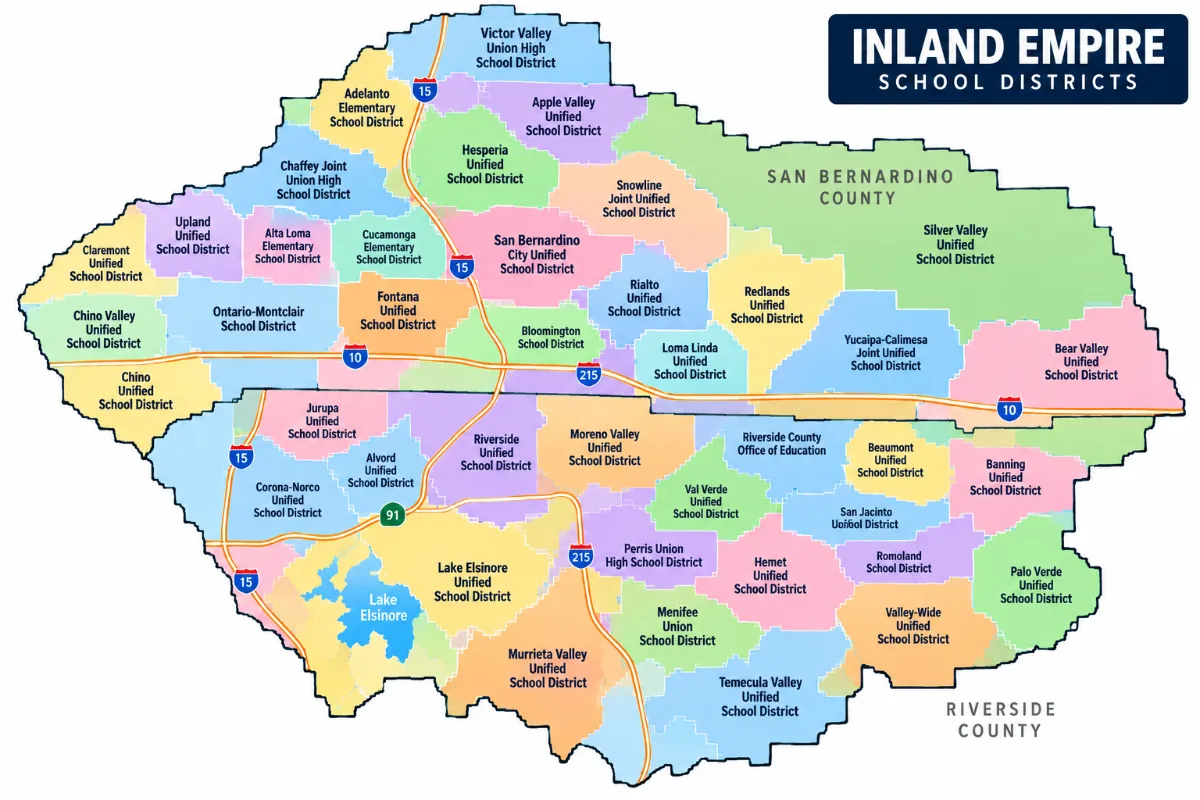
The Inland Empire is served by dozens of public school districts across Riverside and San Bernardino Counties, from large unified districts like Corona-Norco, San Bernardino City and Riverside to smaller elementary and high school districts. School boundaries rarely match city limits, so this map is a useful starting point for families comparing neighborhoods.
Riverside County
- Alvord Unified
- Corona-Norco Unified
- Hemet Unified
- Jurupa Unified
- Lake Elsinore Unified
- Menifee Union
- Moreno Valley Unified
- Murrieta Valley Unified
- Perris Union High
- Riverside Unified
- San Jacinto Unified
- Temecula Valley Unified
- Val Verde Unified
San Bernardino County
- Chaffey Joint Union High
- Chino Valley Unified
- Colton Joint Unified
- Cucamonga School District
- Etiwanda School District
- Fontana Unified
- Ontario-Montclair
- Redlands Unified
- Rialto Unified
- San Bernardino City Unified
- Upland Unified
- Yucaipa-Calimesa Joint Unified
Inland Empire Questions, Answered
What is the largest city in the Inland Empire?
Riverside is the largest city in the Inland Empire, with 314,998 residents as of the 2020 Census, followed by San Bernardino (222,101) and Moreno Valley (208,634). Riverside and San Bernardino are the two county seats.
What cities are in the Inland Empire?
The largest cities in the Inland Empire include Riverside, San Bernardino, Fontana, Moreno Valley, Ontario, Rancho Cucamonga, Corona, Rialto, Murrieta and Temecula. In all, the region spans 52 incorporated cities across Riverside and San Bernardino Counties.
What is the Inland Empire?
The Inland Empire is the metropolitan region of Southern California made up of Riverside County and San Bernardino County, just east of Los Angeles and Orange Counties. The two counties held a combined population of 4,599,839 as of the 2020 Census. Management One has managed rental property across the western Inland Empire since 1983.
How many cities are in the Inland Empire?
The Inland Empire has 52 incorporated cities in total, 28 in Riverside County and 24 in San Bernardino County, spread from Chino Hills in the west to the desert communities in the east. Management One focuses on the populated western corridor and manages rental property in 15 of those cities.
Which Inland Empire cities does Management One manage rental properties in?
In Riverside County: Riverside, Corona, Eastvale, Moreno Valley, Perris, Menifee, Lake Elsinore, Murrieta and Temecula. In San Bernardino County: Ontario, Rancho Cucamonga, Upland, Fontana, Chino and Chino Hills. Each has its own local rental market page with current rent data and a local property manager.
Where is the Inland Empire in California?
The Inland Empire sits inland from the coast in Southern California, east of Los Angeles County and Orange County. Riverside County forms the southern half and San Bernardino County the northern half, bounded by the San Gabriel and San Bernardino Mountains to the north and the Mojave Desert to the east.
Does Management One also manage properties in Orange County?
Yes. Alongside the Inland Empire, Management One manages rental property across Orange County, including Anaheim, Irvine, Huntington Beach, Newport Beach, Costa Mesa and Mission Viejo. See the Orange County map for the full list of cities covered there.
What is the average rent in the Inland Empire?
Rents vary widely across the Inland Empire by city and property type. A three-bedroom single-family home commonly rents from the high $2,000s to the low $3,000s per month, with cities like Chino Hills and Temecula near the top of the range and inland valley cities lower. A free rental analysis gives you a rent range for your specific address rather than a regional average.
Own a Rental in the Inland Empire? Find Out What It Should Earn.
A local property manager reviews your property type, condition and current demand in your specific city, then comes back with a rent range. Free, no obligation.