
Orange County (949) 721-6608 – Riverside County (951) 735-2000

Management One

Orange County (949) 721-6608
Riverside County (951) 735-2000

Management One

Service Animals & ESAs vs. Insurance Companies: What Prevails When the Animal Is a Restricted Breed?

As a property management company, one of the most common questions we get from landlords is:

          “If my insurance policy restricts certain dog breeds, can I deny a resident’s
          emotional support animal or service dog if it falls under that list?”

It’s a critical question, and the answer is one that every landlord needs to understand clearly. On one hand, insurance carriers often impose restrictions on certain dog breeds due to liability concerns. On the other hand, federal housing and disability laws require landlords to make accommodations for residents with disabilities, including those with emotional support animals (ESAs) and service animals.

I will break down the legal obligations, explain how insurance limitations interact with federal law, and outline the steps landlords must take to remain compliant while also protecting themselves and their property.
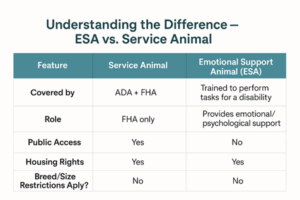
Federal law treats these animals in a very different manner. Service animals have broader protections, including access to public places and stronger legal enforcement. However, both are protected under the Fair Housing Act when it comes to rental housing.

Federal Law Overrides Breed Restrictions

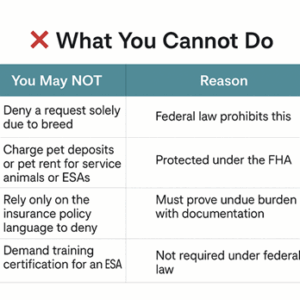
Whether it’s a pit bull, Rottweiler, or German Shepherd, the Fair Housing Act prohibits landlords from applying breed, size, or weight restrictions to service animals or ESAs. The Department of Housing and Urban Development (HUD) and the Department of Justice (DOJ) are very clear:

          Landlords must evaluate accommodation requests individually and may not rely on
          insurance breed restrictions alone to deny them.

Why Insurers Restrict Certain Breeds

There’s no question that dog-related liability is a real financial concern. Here are key stats from the Insurance Information Institute:

  • 22,658 dog bite-related claims were filed with U.S. insurance companies in 2024—a 19% increase from 2023.
  • $1.57 billion was paid out in 2024, representing a 41% increase from the previous year.
  • The average cost per claim was $69,272, up 18% year over year.
  • Over 4.5 million Americans are bitten by dogs annually, with 800,000 requiring medical care.

These rising numbers explain why many insurance policies list “dangerous breeds.” But even with this data, federal housing and disability law still take priority.

What Landlords Must Do When Faced With a Restricted Breed

If a resident’s ESA or service animal is a restricted breed under your current insurance policy, here’s what you’re legally required to do:

  1. Request written documentation from your insurance carrier showing the policy restriction and any denial of coverage.
  2. Obtain quotes from other insurers—show that you explored alternative carriers who might insure the property despite the animal.
  3. Document all communications—including dates, names, quotes, and correspondence.

Unless you can prove that accommodating the animal would cause an undue financial or administrative burden, you must allow the animal, even if it’s a restricted breed.

New Legal Precedent — Chhang v. West Coast USA Properties (Feb 2025)

In a recent federal case, a landlord denied a resident’s request to keep a pit bull as an ESA, citing the advice of their insurance broker. However, the resident sued for housing discrimination under the FHA.

The court ruled:

  • Insurance breed restrictions cannot automatically justify denying an ESA.
  • The landlord failed to show they had verified the actual policy terms.
  • The case was allowed to proceed, reinforcing the resident’s right to be reasonably accommodated.

Key takeaway: Even insurance brokers can be held accountable for misrepresenting policy terms. Landlords must validate everything in writing before taking action.

What About Service Animals and Insurance Conflicts?

If the animal is a service dog, the legal protections are even stronger.

          An insurance company generally cannot deny coverage simply because the service
          animal is a restricted breed.

Under the Americans with Disabilities Act (ADA) and the FHA, service animals must be accommodated without regard to breed or size restrictions.

As a landlord:

  • You must allow the service animal, regardless of insurance policy restrictions.
  • If your insurer refuses to cover your property because of the breed, you are still required to:
    1. Get the denial in writing,
    2. Seek quotes from other providers,
    3. Document all efforts to secure compliant insurance coverage.

Only if you can show that no reasonable insurance option is available may you potentially deny the request, and even then, this is a high legal bar to meet.

What You Can Do

To stay protected and compliant:

  • Require valid documentation for ESAs and a verbal or written explanation of a service animal’s function (only if the disability is not obvious).
  • Require renter’s insurance with animal liability coverage.
  • Use a written ESA/service animal agreement outlining behavior expectations, cleaning, and care standards.
  • Monitor animal behavior and document any issues (e.g., aggression, damage, nuisance).
Your Action Plan

1. Review your current insurance policy’s breed restrictions.

2. Ensure that any denial of coverage is in writing.

3. Proactively identify insurers who accommodate restricted-breed ESAs/service animals.

4. Set up an internal process to evaluate and document ESA and service animal requests.

5. Consult us before taking any action that may result in denial—we’re here to help.

Final Word

Federal law is clear: Disability accommodations take precedence over insurance policy restrictions. As a landlord, the best protection comes from:

  • Understanding the law,
  • Documenting every step,
  • And treating each case individually,
  • Use a third-party company, such as Petscreening.com, to verify the legitimacy of an ESA or service animal. There’s so much fraud that it’s difficult for the landlord to determine if the documents are authentic.

Don’t let misinformation or assumptions expose you to liability. With our team by your side, you’ll stay compliant and confident. Contact us today for expert guidance and peace of mind—because when it comes to fair housing, getting it right matters.


By |2025-07-24T11:57:56-07:00July 24, 2025|Landlord Education, Property Ownership, Resident Education|Comments Off on Service Animals & ESAs vs. Insurance Companies: What Prevails When the Animal Is a Restricted Breed?

A $30 Device That Could Save a Life—And $25 Million

According to the U.S. Fire Administration, residential fires claimed 2,890 lives and injured 10,400 people in 2023 alone, with an estimated 344,600 residential fires reported nationwide. A staggering 60% of home fire deaths occurred in properties without working smoke detectors—a preventable oversight with tragic consequences.

For landlords, this statistic carries serious implications. While many assume that providing a working smoke alarm at move-in fulfills their responsibility, the reality is far more complex. Landlords often rely on residents to replace batteries and report malfunctions, but that assumption can be dangerously optimistic.

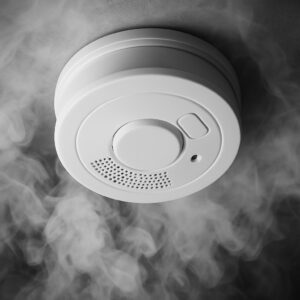
At Management One, we proactively remind our residents—via monthly newsletters—to change their smoke detector batteries twice a year. If a landlord has opted into our annual inspection service, our team physically tests smoke detectors using a smoke-emitting tool and also checks carbon monoxide alarms. It’s not uncommon for us to discover disconnected or chirping detectors tossed in drawers, forgotten and ignored. In these cases, our inspectors educate residents on the importance of keeping alarms installed and functioning—and to report any issues immediately.

Many landlords are unaware that some smoke detectors have a 10-year expiration date. The National Fire Protection Association (NFPA) and the U.S. Fire Administration both recommend full replacement of the unit at that point due to dust accumulation and sensor degradation. Today’s newer models feature sealed 10-year batteries, meaning the entire unit should be replaced before it expires.

Legal Obligations in California

California law is clear. Under Health and Safety Code Section 13113.7, landlords are responsible for the installation and maintenance of smoke alarms. Alarms must be operable at the start of a tenancy and must be repaired or replaced as needed. Residents are legally required to notify the landlord if an alarm stops working.

Per California Residential Code R314, smoke detectors must be installed in:

  • Every bedroom
  • Hallways adjacent to sleeping areas
  • Every level of the dwelling, including habitable attics and basements

Real-World Cases: When Things Go Wrong

 A quick internet search reveals numerous lawsuits where landlords faced devastating legal and financial consequences for failing to provide or maintain smoke detectors:

Akron, Ohio: Four lives were lost in a house fire due to missing smoke detectors. The landlord was sued for $25 million. The case settled for $360,000.

Clinton, New York: Two landlords were charged with second-degree manslaughter after a mother and her one-year-old daughter died in a fire. Investigators found the home lacked functional smoke detectors. The criminal case is ongoing.

Los Angeles, California: Residents sued New Hampshire Apartment, Inc. for widespread habitability violations—including non-functional smoke detectors. Their insurer refused to provide coverage, citing a breach of the policy’s safety warranty. The residents were ultimately left without compensation due to the voided policy.

Gulfport, Mississippi: A tragic fire claimed the lives of a six-year-old and a newborn. Investigators determined the smoke detectors were obsolete and non-functional—a clear violation of building codes. The lawsuit is still pending.

Our Experience at Management One

When Management One recently acquired a portfolio of 123 rental properties, we uncovered a common theme: most homes lacked the proper number of working smoke detectors and some properties had none. In nearly every case, landlords were unaware of the issue.

Key Takeaways for Landlords:
  • Test smoke and carbon monoxide detectors annually and document results.
  • Replace expired units (typically every 10 years).
  • Install detectors in all required areas.
  • Don’t rely on residents to maintain critical safety devices.
  • Verify insurance coverage and ensure compliance with safety requirements.

Smoke detectors are not optional. They are life-saving devices—and a critical legal safeguard. Overlooking something as simple as a $30 alarm could result in a lawsuit, the loss of your property, or even criminal charges.

At Management One, we go a step further by using specialized smoke and carbon monoxide emitters to test each device. This ensures the entire system is functioning properly—not just that the battery works. Our testing confirms that smoke can enter the sensing chamber and that the alarm responds appropriately, providing a more thorough and reliable safety check.

By |2026-04-03T06:43:13-07:00June 3, 2025|Landlord Education, Maintenance, Property Ownership, Resident Education|Comments Off on A $30 Device That Could Save a Life—And $25 Million

Section 8 Housing: Are Landlords Required to Accept It?

Do you remember the classic Clint Eastwood film The Good, The Bad, and The Ugly? For many landlords, working with the Section 8 Housing Voucher Program can feel similar—there are clear benefits, but also challenges that require additional effort and consideration.

As of December 2022, over 7.5 million individuals across the U.S. lived in households supported by housing vouchers. In Riverside County alone, more than 10,000 residents benefit from this federally funded rental assistance.

Established under the Housing and Community Development Act of 1974, the Section 8 program was created to ensure that low-income families could access safe, decent, and affordable housing in the private rental market—outside of traditional public housing.

For decades, many private landlords declined participation due to administrative burdens and perceived complications. However, in recent years, California’s legal landscape has shifted significantly.

Legal Obligations for Landlords

Effective January 1, 2020, California enacted Senate Bill 329 and Senate Bill 222, which prohibit landlords from rejecting applicants solely based on their use of a housing voucher. This includes Section 8, VASH (Veterans Affairs Supportive Housing), and other forms of rental assistance.

Housing vouchers are now legally recognized as a protected source of income under the California Fair Employment and Housing Act (FEHA). As a result, landlords may not advertise or indicate in any way that they do not accept vouchers. Doing so is considered discriminatory under Fair Housing laws and may result in fines, legal action, and reputational damage.

These laws are actively enforced through complaint investigations and “mystery shopping” practices conducted by Fair Housing agencies.

What Landlords Must Know About Voucher Applicants

When screening residents with housing vouchers, landlords must follow specific guidelines:

  • Income Qualification: Income multipliers (e.g., 3x rent) must be based only on the applicant’s portion of the rent—not the full amount. For example, if rent is $1,500 and the tenant’s responsibility is $300, the income qualification must be based on the $300.
  • Credit Screening: Landlords may not disqualify voucher holders based on credit scores alone. However, screening for rental history, prior evictions, and background checks remains permissible.
  • Additional Requirements: Participating in the program entails administrative steps such as a housing authority inspection, habitability certification, and lease approval—all of which may extend the leasing timeline.

How the Voucher Qualification Process Works

Applicants seeking Section 8 assistance must:

  • Join a waitlist, often months or years long due to high demand
  • Select a housing region and meet income limits set by local agencies
  • Verify legal U.S. residency for at least one household member
  • Undergo background checks, with exclusions for certain offenses
From “No Section 8” to Inclusive Advertising

In the past, landlords frequently used phrases like “No Section 8” in their listings due to procedural delays. Today, such statements are prohibited under California law.

This includes language used in online listings (Craigslist, Zillow, personal websites), printed ads, and communications from leasing staff. All employees and agents must be trained to respond appropriately to voucher inquiries. Stating “we do not accept vouchers” is now grounds for a Fair Housing violation.

Dispelling Section 8 Myths

Some landlords worry about increased risks with voucher tenants. However, Section 8 residents are bound by the same lease terms as all other tenants. Violations—such as non-payment, damage, or illegal activity—can still result in eviction and legal action.

Additionally, tenants risk losing their voucher if they breach lease terms, which provides additional incentive for program compliance. The accountability built into the program often results in long-term tenancies and reliable rental income.

Additional Protected Classes

In addition to housing voucher recipients, military personnel and veterans are also covered by California’s source-of-income protection laws. These groups may not be discriminated against based on how they pay rent.

What It’s Really Like to Lease to a Section 8 Tenant

The qualification process for Section 8 renters is extensive. At Management One, we work closely with the Riverside and San Bernardino County Housing Authorities, each of which has a unique approval process.

Riverside County Requirements

To lease to a Section 8 tenant in Riverside County, both the management company and the resident must complete a 17-page packet. Alongside this packet, landlords must submit:

  • IRS documentation confirming the EIN
  • A voided check
  • The signed management agreement
  • A completed W-9 for Management One
  • A signed owner statement verifying homeownership

Once submitted to the caseworker, the packet is forwarded to the RFTA (Request for Tenancy Approval) department. This team reviews the applicant’s income, rent amount, and utility costs using a sliding affordability scale. The analysis includes whether appliances are gas or electric and adjusts for utility provider rates.

If the proposed rent exceeds what is deemed affordable for the applicant, the RFTA department will submit a counteroffer—sometimes only $50 lower, other times up to $500 or more. If the reduced amount is acceptable to the landlord, the process continues. If not, the application is denied, though landlords must ensure the same rental terms would also disqualify a non-voucher tenant to avoid discriminatory practices.

After approval, our team performs a limited credit review (looking for prior evictions or rental debt), verifies rental references, and confirms the tenant earns 3x their portion of the rent. The applicant must then submit their portion as a holding deposit.

Meanwhile, the property must undergo a HUD inspection before move-in. One of the most common reasons for failed inspections is non-compliant GFCI outlets near water sources, which we proactively address during property rehabs. If a property fails, landlords have 10 days to correct issues before re-inspection.

It’s important to note: No tenant may move in until the home passes inspection, regardless of what was listed in the lease agreement.

San Bernardino County Requirements

San Bernardino County follows a similar process, with a few additional documentation requirements. In addition to the packet:

  • A copy of the deed must be submitted
  • A W-9 is required for each owner listed on the deed
  • If the property is in a trust, the full trust documents and W-9s must be provided
  • The management agreement and a W-9 for Management One are also required

Unlike Riverside County, San Bernardino often asks landlords to pre-qualify the applicant before the housing packet is submitted.

Once approved, HUD schedules an inspection, and landlords must resolve any cited issues before the tenant may take occupancy. First payments typically take 4–6 weeks after move-in. Thereafter, HUD payments are deposited like clockwork on the 1st of the month.

Ongoing Management and Communication with HUD

After a Section 8 tenant moves in, ongoing communication with HUD is required. The agency is often understaffed, and changes—such as updates to a tenant’s income—may take 4–6 weeks to process. Payment adjustments and recertification notices are issued regularly, sometimes up to six times per year, plus one annual recertification.

Although the program has its complexities, we’ve found that understanding the process and working within both HUD’s and Management One’s frameworks enables us to better serve our residents and protect our property owners’ interests.

By |2025-04-28T11:11:46-07:00April 28, 2025|Industry News, Landlord Education, Property Ownership, Resident Education|Comments Off on Section 8 Housing: Are Landlords Required to Accept It?

New California Landlord Laws: What You Need to Know

As of January 1, 2025, several new laws affecting landlords in California have come into effect, aiming to enhance tenant protections and promote transparency in rental practices. Key changes include:

  1. Tenant Screening Procedures (AB 2493):

  • Application Fees: Landlords can charge a potential tenant an application screening fee only if they accept applications in the order received and approve the first applicant meeting the established screening criteria. We have always done this at Management One so this does not affect us.
  • Disclosure of Criteria: Landlords must provide their screening criteria in writing alongside the application.
  1. Security Deposit Documentation (AB 2801):

  • Photographic Evidence: Landlords collecting a security deposit are required to take photographs of the rental unit:
  • Immediately before, or at the start of the tenancy.
  • Within a reasonable time after the unit is returned, prior to any repairs or cleaning for which deductions from the security deposit will be made.
  • After completing any repairs or cleaning.

         Provision to Tenants: These photographs must be provided to the departing tenant.

  • Implementation Dates:
  • For tenancies ending on or after April 1, 2025, landlords must take photographs after possession is returned.
  • For tenancies beginning on or after July 1, 2025, landlords must take photographs at the start of the tenancy.
  1. Positive Rent Payment Reporting (AB 2747):

  • Offer to Tenants: Landlords of residential rental properties are required to offer tenants the option of having their positive rental payment information reported to at least one nationwide consumer reporting agency.

         Frequency of Offer:

  • For leases entered into on or after April 1, 2025, the offer must be made at the time of the lease agreement and at least once annually thereafter.
  • For existing leases as of January 1, 2025, the offer must be made no later than April 1, 2025, and at least once annually thereafter.
  1. Rental Payment Methods (SB 611):

  • Fee-Free Options: Landlords must offer at least one fee-free method for rent payment, ensuring residents are not charged additional fees for valid check payments, even if electronic methods are preferred. Should you have any properties that aren’t managed by Management One, take note of this as it will affect you.
  • Military Personnel Considerations: Landlords are now required to provide explanations when requesting larger security deposits from military personnel.
  • Prohibition of Posting Fees for Notices: Landlords are now prohibited from charging tenants any fees for the preparation, delivery, or posting of termination notices, such as a 3-Day Notice to Pay Rent or Quit. This change eliminates additional financial burdens on tenants facing potential eviction and encourages equitable treatment in the landlord-tenant relationship. It is important to note that this adjustment presents significant operational costs for landlords and property management companies, including labor, transportation, and fuel expenses related to notice delivery.

Management One is in the process of updating its practices with our landlords to ensure full compliance with the new regulations.

Resident Screening Procedures (AB 2493)

For the last 40 years, Management One has accepted applications on a first come-first serve basis. We believe this is the fairest way to rent properties and remain above board with Fair Housing.

Security Deposit Documentation (AB 2801):

We currently take photos for all resident security deposit charges and provide them to the departing residents. Effective April 1st, 2025, we will start taking additional before and after photos to be in compliance with the new law. This takes a lot of  additional labor time to comply with this law as well.

Positive Rent Payment Reporting (AB 2747):

We currently use an online payment platform that offers residents the option to have their rental payment history reported to their credit.

Rental Payment Methods (SB 611):

Fee-Free Options: We currently allow residents to pay by cashiers check or money order along with paying online.

Military Personal Security Deposit– the law already only allows for Management companies and landlords to collect a security deposit equal to one-months rent, so we don’t have to worry about this.

Termination notice fees: We currently charge the resident a $100 posting fee for 3-day notice to pay or quit. Effective April 1st, Management One will charge the landlords $75 posting fee and Management One will take a $25 loss.

We are committed to working closely with our legal counsel to ensure that Management One and our clients remain fully compliant with new laws and Fair Housing regulations.

As legislation evolves, we will continue to provide timely updates to keep you well-informed and prepared.

By |2025-01-08T16:32:40-08:00January 8, 2025|Industry News, Landlord Education, Property Ownership, Resident Education|Comments Off on New California Landlord Laws: What You Need to Know

Top 5 Neighborhoods in Menifee, California

Menifee, California, has a population of 116,834. Menifee is in Riverside County. Living in Menifee offers residents a sparse suburban feel, and most residents own their homes. In Menifee, there are a lot of parks.

Many families and retirees live in Menifee, and residents tend to have moderate political views. The public schools in Menifee are above average.

With all the different neighborhoods Menifee offers, it can be tough to decide where to live. I’ve selected five great neighborhoods based on my tenure in property management.

Let’s tour the city, shall we?

1. Andalusia

Andalusia is a gated common interest development community of 104 residences, each with its own private entrance. Their buildings and landscaping feature Mediterranean architecture reminiscent of the Andalusia region in Spain. This wonderful community offers a pool and clubhouse.

The common area includes a stunning pool, spa, recreation center, and more than 100 palm trees. The unique environment is further enhanced with a beautifully designed palm grove near the large central water fountain and a rose garden near the pool.

At night, well-placed lighting emphasizes the beauty of the architecture, fountains, and landscaping and makes it a joy to walk around the streets of their safe community.

The average rental rate for a 3-bedroom home in Andalusia is $ 3,207 a month. The average purchase price for a 3-bedroom home is $ 362,000.

2. Menifee Lakes

Menifee Lakes is a spectacular gated community.  Offering three lakes, several parks, and miles of walking trails, Menifee Lakes is a highly sought-after community. Residents of the lake enjoy fishing, kayaking, and boating. If that’s not enough, residents can visit the Bay Club, where you will find waterslides, two refreshing swimming pools, and a fitness center. Not to mention the 20,000 square foot event center is spectacular.

Be sure to golf a few rounds at the Menifee Lakes Country Club. Featuring lush 36 acres of rolling greens, challenging fairways, and more. The great Ted Robinson influenced much of the design of this stunning course.

The average rental rate for a 2-bedroom home in Menifee Lakes is $ 2,481 a month. The average purchase price for a 2-bedroom home is $ 563,000.

3. Park Ridge at Menifee Town Center

Enjoy resort-style living at Park Ridge. Park Ridge is a masterplan community made up of new single-family homes. Residents of this amazing community can enjoy amenities such as a 5-acre park, walking trails, and a state-of-the-art recreation center.

Love wine tasting? You’re in luck the Park Ridge is a short 20-minute drive to Temecula’s wine country. Don’t feel like driving? No problem, enjoy the many delicious restaurants located in the Town Center.

The average rental rate for a 3-bedroom home at Park Ridge is $ 3,010 a month. The average purchase price for a 3-bedroom home is $ 510,000.

4. The Oasis

The Oasis is a beautiful community surrounding the 36-hole Menifee Lakes Country Club. This well-established community offers reasonably priced homes, great amenities, and an active lifestyle. It is ideally set in the heart of southern California within an hour of the ocean and the desert.

The gorgeous clubhouse includes a fitness center, grand ballroom with stage, arts and crafts studio, billiard room, and library. Outside, residents can enjoy tennis, bocce ball, and shuffleboard courts.

Plus, the glorious California sunshine by the outdoor pool and spa. The barbecue area is a great place to mingle with neighbors and meet new friends.

The average rental rate for a 2-bedroom home in The Oasis is $ 2,654 a month. The average purchase price for a 2-bedroom home is $ 553,000.

5. Sun City

Sun City was the first master-planned community of its kind in this area. Low-maintenance single-family homes and attached homes provide open floor plans perfect for today’s active adult buyers.

Residents can get in touch with their creative side in the woodworking shop, lapidary studio, and ceramics studio. There is also a card room, fitness center, billiards room, table tennis, and indoor shuffleboard courts.

Sports enthusiasts can attend a Lake Elsinore Storm minor league baseball game or play a round of golf at the Menifee Lakes Country Club. The Santa Rosa Ecological Reserve and Diamond Valley Lake provide gorgeous views while fishing, hiking, or boating.

The average rental rate for a 3-bedroom home in Sun City is $ 2,455 a month. The average purchase price for a 3-bedroom home is $ 417,000.

If you want to rent a home or purchase in one of these fantastic communities, Management One and our affiliates can help. We have a dedicated leasing team that loves to help families find their next home.

By |2024-10-30T10:00:14-07:00October 30, 2024|Lifestyle, Property Ownership, Resident Education, Uncategorized|Comments Off on Top 5 Neighborhoods in Menifee, California

Do I have to accept Section 8 in California?

Do landlords in California have to accept Section 8?

Yes, landlords do have to accept Section 8.

The Section 8 Housing Choice Voucher program, a federally backed program, is a form of government rent assistance. According to the Housing Authority of Riverside County, pre-COVID, the wait list for housing vouchers was 80,000 applicants. As of July 2023, 137,000 applicants were waiting for funding.

When Congress established Section 8 of the Housing and Community Development Act in 1974, one goal was to ensure that people earning low wages could find “decent housing and a suitable living environment” outside public housing units.

On January 1, 2020, California implemented two bills requiring landlords to accept Section 8 or housing vouchers as an income source from applicants. Rental property owners and management companies cannot discriminate against an applicant or deny the application because they have a housing voucher.

Section 8: How Section 8 Housing Regulations Work

Do you remember the Clint Eastwood movie “The Good, The Bad, and The Ugly?” Some landlords equate renting to residents on Section 8 the same way. With a guaranteed rent payment each month, renting to a Section 8 tenant has its advantages; but it also presents challenges that can be very time-consuming to navigate.

Today, people who meet income requirements can apply to the program to receive a voucher when it becomes available. If they are approved and selected and then find an apartment or house with the voucher, their local housing authority sends payments directly to landlords or the property management company.  The payments cover some or all of the voucher holder’s rent. The payments aim to make housing more affordable for voucher holders by ensuring each household pays no more than 30% to 40% of its income on rent.

Before the 2020 legislation that made it mandatory to accept Section 8 vouchers, it was common for property owners to advertise that they did not participate in Section 8 and wouldn’t consider any residents with a housing voucher.

This practice was common because participating in the Section 8 program was seen as an administrative burden. There are many hurdles to cross, including a home inspection, verified habitability, and an approved residency. The delay in getting approved and prepared could cost landlords money in lost rent.

On the other hand, some landlords appreciated the Section 8 program, seeing it as a guaranteed source of income. You know the rent will come in every month because it comes from a government agency, not an individual. However, for most owners, the Section 8 process was seen as a waste of their time. With the legislative change, all landlords and property management companies must accept Section 8 and housing voucher applicants.

Section 8: 2024 Applicant Rental Criteria Changes

Before January 1st, 2024, landlords could use the same criteria for all applicants, Section 8 and Non-Section 8, when qualifying an applicant for a home.

If your requirements state that all residents must have more positive than negative credit, all applicants must meet that criteria.

As of January 1st, 2024, Section 8 applicants must be asked if they want their credit evaluated. They can elect not to have their credit considered as part of the process. The thought behind this law is that most people with housing vouchers are there for a reason, and most likely, their credit will not meet the standards to qualify for a home.

Fair Housing Is Checking for Compliance

The passage of SB 329 and SB 222 means that California residential landlords throughout the state will no longer be able to say they don’t participate in Section 8, VASH, or other rental assistance programs. Now, tenant’s rights groups assess whether landlords are aware of and complying with the law. Landlords who don’t currently participate in rental assistance programs are advised to respond to inquiries about whether they accept Section 8.

This change means that ads can no longer state that Section 8 is not accepted. The Fair Employment and Housing Act (FEHA) states:

that it is unlawful to make, print or publish or cause to make, printed or published any notice, statement, or advertisement concerning the sale or rental of a housing accommodation that indicates any preference, limitation, or discrimination based on any enumerated protected class, including a source of income. Accordingly, it is essential that all advertising (including ads posted on personal and third-party websites such as Craigslist) be revised to remove any references such as “No Section 8” or “We do not participate in Section 8”.

Jumping the Section 8 Housing Hurdles

Since the new legislation came into effect, Management One has processed over 30 Section 8 applications. We’ve learned how to navigate Housing Authority hurdles. It’s important to note that just because an applicant has a voucher, or an F-sheet doesn’t mean they qualify for the property they are applying for.

We highly recommend you call the Housing Authority office and inquire about the applicant and provide them with the specifics of the property they are applying for. When approving an application, Housing looks at what utility company services the property, the rental rate, and if the appliances are gas or electric. If the applicant doesn’t qualify for the property, there’s no sense in spending time filling out the 34 pages that make up the application.

The approval process takes about one to two weeks. If the application is approved, the next step is the inspection. Inspectors assess the property to ensure it’s safe for the incoming resident. You may have heard horror stories about Housing coming in and making a laundry list of demands before they will approve an application. However, we’ve found that’s not the case. In our experience, if a home fails a Housing inspection, it’s usually because the property was built to what is now an outdated code standard that needs to be updated.

Once the home passes inspection and the resident moves in, the Housing Authority can take up to six weeks to send the payments. In the meantime, the resident is responsible for paying their portion of the rent. Once the Housing Authority establishes the payments, they come in like clockwork on the first of each month.

Working with the Federal Government requires a lot of work and patience. Knowing how to navigate these hurdles yourself or teaming up with a management company familiar with the process will give you peace of mind.

Another article that California landlords need to be aware of is the New Security Deposit Law.

By |2024-09-30T11:25:27-07:00September 30, 2024|Industry News, Landlord Education, Resident Education|Comments Off on Do I have to accept Section 8 in California?

Air Conditioning Maintenance in California: Tenant or Owner Responsibility?

In the sweltering heat of Southern California, rental property air conditioning maintenance is not just a matter of comfort—it’s a critical issue of habitability and resident satisfaction.

While there may be debate over who should bear the legal responsibility for maintaining these systems in rental properties, there are compelling reasons why landlords should take the lead. For owners, not only is it a matter of resident satisfaction and retention, but it is also a consideration around property preservation and, ultimately, keeping down expensive air conditioning unit replacement costs.

In this article, we’ll look at the legal, financial, and practical benefits of landlords maintaining air conditioning units, ensuring their properties remain safe and comfortable.  At the same time, we’ll identify the importance of resident responsibility around basic maintenance tasks such as regular filter changes.

  1. Legal Obligation for Habitability: In California, landlords are legally required to provide and maintain a habitable living environment. In regions like Southern California, where temperatures can soar, functional air conditioning systems are essential to ensure the property remains habitable. Failure to maintain these systems could lead to violations of Fair Housing standards, exposing landlords to legal risks.
  2. Resident Satisfaction and Retention: A well-maintained cooling system significantly contributes to resident comfort, especially in Southern California’s hot climate. When landlords take responsibility for maintenance, it fosters good resident relations, leading to higher satisfaction, fewer complaints, and longer tenancy, which reduces turnover.
  3. Preservation of Property Value: Regular cooling system maintenance helps preserve the property’s value by preventing damage caused by overheating, water intrusion from plugged lines, mold, or other issues that can arise from poorly maintained AC systems. Landlords who invest in regular upkeep protect their long-term investment and avoid costly repairs or replacements down the line.
  4. Energy Efficiency and Cost Savings: Proper cooling system maintenance ensures AC units operate efficiently, reducing energy consumption and lowering utility bills. While all residents in Management One properties pay utility bills, an energy-efficient system can be a selling point for prospective residents and reflects positively on the property’s overall management.
  5. Liability and Risk Management: If a cooling system fails due to lack of maintenance and results in property damage or health issues for residents, landlords could be liable for negligence. Landlords mitigate these risks by assuming responsibility for maintenance and avoiding potential legal disputes and insurance claims.


Management One’s Approach to AC Maintenance

Ten years ago, we implemented a policy that during vacancies properties under went a heating and cooling system tune-up. The vendor services the whole system, including changing out the AC filters. We’ve found this policy has paid great dividends for landlords and residents alike. Before making this change, 8 out of 10 residents would move in, and there would be an issue with the AC or heater. There is nothing more disheartening than moving into a new home in the middle of summer and finding out the AC unit isn’t working correctly. Ensuring property habitability and a new resident’s comfort goes a long way in establishing trust and long-term harmony.

Owners’ AC Maintenance Responsibilities

Effective September 1, 2024, Management One implemented a new program to help ensure the longevity of heating and cooling systems. Once a year, during the annual inspection, we will have the AC and heating system tuned up, and the AC filter changed. This tune-up includes cleaning and servicing the inside and outside units. The basic cost to the landlord is $110, with any required repairs beyond the tune-up, at an additional cost.  This provides our owners the peace of mind that comes with knowing the ongoing status of their property’s cooling system and the ability to plan for future replacement costs.

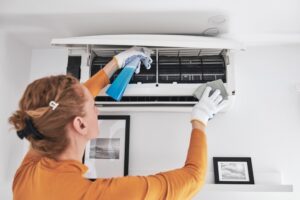
Residents’ AC Maintenance Responsibilities

You might be asking yourself doesn’t the resident have any responsibility for helping to maintain the AC units and their comfort? The answer is, yes, they do! Their lease agreement requires them to change the AC filter every 90 days. Having a professional company service the system annually and giving it a once-over benefits landlords. We can prevent a burnt-up compressor from a dirty filter or loss of all the freon due to a leak. The inspector will also report to us if the resident has kept up with filter changes. If they haven’t the resident will be fined $100 for a first violation and $200 the second time.  They will also be subject to their lease not being renewed.

In conclusion, it’s to their own benefit that landlords be responsible for maintaining air conditioning systems in Southern California rental properties. By ensuring these systems are adequately maintained, landlords fulfill their legal obligations around habitability, enhance resident satisfaction, and reduce the risks associated with system failures, protecting their property investments. Ultimately, proactive maintenance of cooling units is a wise and necessary practice that benefits both landlords and residents, fostering a positive rental experience and ensuring the property’s long-term success.

Below is a List of our Top Picks for Air Conditioning Companies in Orange County, CA.

By |2024-09-04T14:53:02-07:00September 4, 2024|Landlord Education, Maintenance, Resident Education|Comments Off on Air Conditioning Maintenance in California: Tenant or Owner Responsibility?

Fire Safety: Learn How You can Prevent a House Fire

If only Smokey the Bear hung out in people’s homes during fire prevention month when he’s not chilling in the forest, a lot of mayhem could be avoided. On the other hand, a bear in the house isn’t that great an idea either. That, and a single month for fire prevention? Seem, oh, I don’t know, 11 months shy?!?

It’s Everywhere, All the Time

Whether you own a property, several properties, land, or rent a property, fire awareness, and fire prevention, ought to be right about the top of your list of concerns. Think about it, the news is rife with natural disasters all the time, all over the world, yet we, as humans, always see these things as “them” versus us. That simply is not true. It CAN be you.

As a topic

Now, fire prevention is a rather dry topic. You rarely see folks gathered around in a burger joint discussing this topic in earnest. Firefighters, okay, you got me there, but not regular folks. Ever. As a matter of fact, it would not be ‘front of mind’ for me, either, as I’m a relatively normal person.  The jury’s still out on that, by the way. However, working in the insurance field for some time I got to see and learn that sometimes bad things happen, and an ounce of prevention, well, you know the rest.

It Starts Outside

I’m going to have to read up the on some refreshers here, my old insurance stuff, as I’m rusty on this, but I can pass some good info here anyway. Rules of thumb: if you have 20,000 or more square feet of brush near your home, you have a serious fire hazard on your hands. That’s roughly the size of a football field, including the end zones. Brush within 500 feet or less of your domicile? There’s an issue there. Fire hydrant over 500 feet from your house? Dry hydrant? No visible address on your house? Wood stacked against your house, brush in your back yard? All of these are issues. Oh, by the way, a dry hydrant is an unpressurized pipe that sticks out of the ground and taps into a water supply, like a nearby body of water, which the water must be sucked out of to be used, versus a pressurized fire hydrant. They are more common than you may think.

But wait, there’s more

Hey, lots of people have chimineas or fire pits, right? If you have one, your insurance rates are going to go up. They are a fire hazard.

Also, not pulling a permit when altering your property can have devastating consequences. We’ll touch on this some later.

Now let’s go inside

Most homes are built to a specific building code that is designed for safety, uniformity, as well as compliance with local laws. Building inspectors from the local government serve a purpose. They are trained to spot deficiencies in the building process, and this includes all of the things that kill you, like fire.

First, let’s touch on some commonsense items.

Should you smell natural gas, shut off the gas at your gas meter and call the gas company, stat! Don’t bother hunting the leak down, let a trained professional handle this.

Your smoke detectors are chirping, what to do? Erm, change the batteries? Am I being facetious? Nope. Let me explain.

Storytime:

My granddaughter has a lot of friends, but there are two she’s talking with all the time. One life down the block in a rental, (not one of ours), and every time I go there to retrieve her (Dinner time, time to come home!) I can hear the smoke detectors chirping inside. All of them. All the time. I have talked to the father, but he does not seem to think it’s of any importance.

The other friend she walks to school with. Each morning they get on the phone and talk about what they are wearing and stuff like that. And, each morning, my dogs cower. My dogs are scared to death of chirping smoke alarms. I have some weird dogs. Anyway, since both girls are on speakerphone, my dogs can hear a chirping smoke alarm at the other girl’s house. On the way home tonight, I’m picking up a pack of 9-volt batteries for my granddaughter to give to them.

Leading the Horse to Water but

However, I cannot make them put the batteries in, but at least they have that option. You see, in both cases, the smoke alarms are house-powered and interconnected, so these folks think all is well, despite the chirping. So, what happens in an electrical fire? Usually, the electrical panel fails, and those battery backup smoke detectors are running only off the batteries. But if the batteries are dead…

By the way, each hallway, meaning the downstairs and upstairs hall, and each bedroom ought to have a smoke detector. Nowadays they make smoke detectors that have 10-year batteries installed. If your smoke detectors are strictly house powered, old, painted over, damaged, do not sound, get rid of them, and upgrade to the new types!

Clothes Dryers Are Killers

That load of wash you’re sticking into the dryer does not give a hoot nor holler about fire prevention. It’s just a dumb, heavy machine, not like you, you’re smart. You regularly clean the lint trap before each load, and yearly (and no less than every three years) clean out the duct that runs to the outside, right? Oh, you don’t? You’re not the only one.

Cleaning the lint trap before every load is imperative! Equally, so is the regular cleaning of the ductwork. My brother-in-law got the most expensive free dryer ever a few years ago. On the first day of having it, he started a batch drying before going out to dinner. That dryer burnt down half the house.

Home depot has products that will help you clean that ductwork as part of your fire prevention routine!

Santa’s Main Entry

When was the last time you cleaned the inside of your wood-burning fireplace chimney? Three years or more? Call a chimney sweep, you know, like the guy from Mary Poppins. You may think chimney sweeps are outdated and long gone, but you would be mistaken. They are still around and serve an important function. That creosote buildup going up your fireplace can ignite! What Is Creosote?

That Pot Belly in the Corner

Wood-burning stoves are an anachronism. Unless you live in the mountains, or out in the sticks, you may have never even seen one up close and personal. They provide a lot of heat, and they have their own special charm. And they are dangerous.

A good rule of thumb is to keep said stove 36 inches or more away from anything combustible. Almost all wood-burning stoves made since the 1970s have data plates or stickers that inform you, the end-user, the proper distances for each model. If you’re considering buying one, let a qualified and licensed/insured professional install it. Said pro would make sure the clearances are correct and will install a proper sleeve in the ceiling or wall where the vent pipe will exit. Also, you want to make sure there is nonflammable flooring beneath the until extending to lea than 18 inches out from the fire door. Again, local ordinances vary, so check and do it right once.

That Big Beautiful Flat Spot

This happens all the time: You take something into the garage to store, and “dang it, where am I going to set this down at?” You spot that area right near the water heater or furnace; it’s open, it’s flat, bingo! Hold on there, Charlie! (Sorry if your name is Charlie, by the way). Keep at least 36 inches around the water heater and furnace free of any combustible items! 7% of household fires start right here, and 4% of household fire deaths.

Now You’re Cooking

If you’re leaving the kitchen for any length of time, turn your kitchen burners off! I have walked out of the kitchen many times and gotten distracted by something and burned the life out of dinner.

Also, if you have a grease fire, do NOT try to out it out with water! I almost did this once and was lucky not to have burned down the house. My wife grabbed my shoulder, yelling something to the effect of “Hey, stupid, what are doing!!?!” She grabbed some flour and doused the flames. Yes, the cleanup was a mess, but it would have been worse had I did that thing. Grease fires happen. Don’t make it worse!

The Match Game

My son, he’s really something. I’m very proud of how he turned out. It was dicey there for a bit. He LOVED to play with matches when he was little. He lit a recliner on fire once, and a large stack of newspapers in the side of the garage another time.

Do yourself a favor and put matches away somewhere high and safe. You can take fire prevention seriously, but kids, they don’t, not so much. I was that little goofball who’d a light paper on fire with a magnifying glass.

Heat That Space

But use the furnace the house came with. Space heaters are big business, and they are dangerous! As an insurance inspector, if I found a space heater in a home, and I was required to look, instant fail. Either the coverage rates would skyrocket, but more often than not, the policy was at risk for cancelation. “But mine shuts off if it’s tipped over!” Well, it’s designed to, but that does not mean it will every time.

The Panel

This tidbit is the most expensive fix. Electricity is no joke. It will shock you to death, but it can also cause fires! Here’s something people rarely think about: If you have ever muttered to yourself “Dagnabit, the breaker clicked off again!”, you’re probably asking that particular circuit to provide more juice than it can provide. You see, when a breaker is new, it is rated at a certain amperage. That 15-amp breaker, when it’s new, permits 15 amps to pass to the lines in the home, but over time that amperage drops. Corrosion, wear, and that bane of all us now living, time takes its toll. On the other hand, if you’re plugging in an appliance that draws, say, 20 amps, into a line rated at 15 amps, you’re asking for problems.

What happens at the wires in the walls is called resistance, and resistance creates heat. Enough and the wire will melt, and can also, potentially, catch fire. Check your appliance first; its amp draw should be on its plate or sticker.

More on the Panel

Your house, if built before 1980 or so (and I have seen this in as later as 1990 builds), may have a dangerous electrical panel. For example, Federal Pacific panels tend to nut trip breakers when overloaded, and fires result. Zinsco panels tend to have their breakers melt when overloaded. Zinsco panels can be labeled simply Zinsco, Sylvania Zinsco, or GTE Sylvania Zinsco. Both of these dangerous panels are very distinctive looking. However, I have seen folks remove the labeling, even going so far as to fabricate custom door-covers so that, unless you open the cover, you would not know you’re dealing with a naughty box.

If you’re in doubt, Google the above product names and you’ll see, 1) why I bring this up, and 2) images that will show you what to look for. You’ll spend 2 to 4 grand to replace the panel, but aren’t you and your family worth at least that?

Permits, as Promised

Okay, see it was not an empty promise. Building permits are important for several reasons. For starters, if significantly altering your house, it’s the law. Many people skirt this though, and when it comes time to sell your house, you may not qualify for a buyer using FHA financing. That can stall, or even kill your sale. But here is a more compelling reason:

If the code enforcement-building inspector-permit person signs off on it, you’re pretty much golden. That professional eye is detail-oriented. What does that have to do with fire prevention? Well, they know that aluminum Romex (a type of wiring) is a no-no. They know that the Zinsco electrical box your handyman scored at a garage sale is a no-no. They know the proper tolerances of specific items.

Don’t be a permit pariah.

The Rap Wrap

There are so many other things I can list, but my best advice? Use common sense. Use licensed/insured contractors always. Always err on the side of caution. Do it right.

As Smokey the Bear might say, only you can prevent (forest) fires. I would add to that; fire prevention is everyone’s job.

image with text "Ready to talk to Tyler about an investment property? Call him at 951-735-2000"

By |2023-09-20T15:24:32-07:00September 20, 2023|Resident Education|Comments Off on Fire Safety: Learn How You can Prevent a House Fire

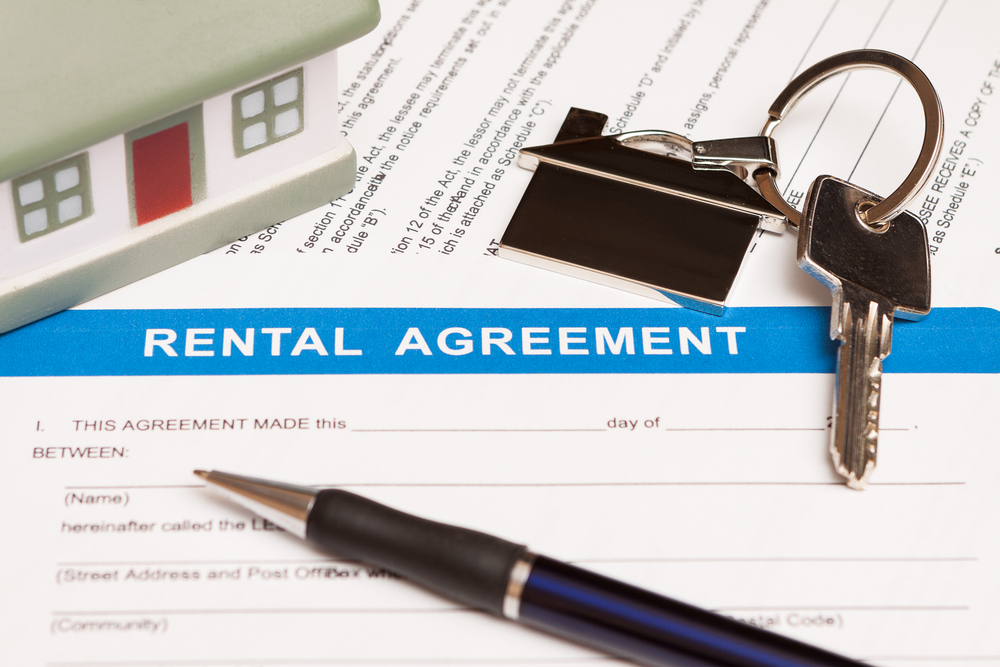
Rental Agreement: 10 Things You Should Know Before Signing

Today is the day you move into your new home! Before you can do that, you have to sign your rental agreement or lease and get the keys to your home.  A rental agreement is legally binding, and its purpose is to protect both the resident and the owner and/or property management company. Let’s be real here for a moment, reading and signing lengthy documents is boring. However, it is a necessary evil that must be done.

In Management One, we try to make the process smooth and painless, fun even, for our clients. We throw a “Welcome Party” complete with balloons, gifts, and we even have your name on all eight jumbo TV screens in our office. Residents can review the entire agreement via email from the comfort of their own home before signing in our office. By emailing the agreement ahead of time, our new residents can review it without us looking over their shoulders. On the actual day of signing, I walk the residents through the lease/rental agreement and “review” the most important parts.

Knowing the information that is in your lease/rental agreement is very important. Over the next few minutes, I will share with you the top 10 items; you should pay close attention to in the lease/rental agreement you are about to sign. There is nothing worse than finding yourself in a situation and hearing the dreaded words “well, you should have read the fine print.”

Important sections to review before you sign any lease/rental agreement

1. Lease Term, Renewal, and Termination

Generally, a standard lease is for a 12-month period. The lease term can vary depending on the owner, landlord, and/or property management company. Make sure the start date and end date are correct, especially if you made special arrangements for a different rental term.

As your lease term comes to an end, it is common to get notice 30 or 60 days before renewal of your lease. Typically, you will have two options, renew the lease for another year or go month to month. If no notice is given, the lease expires and/or becomes month-to-month automatically, which most commonly results in a larger increase in rent.  Compared to, if you signed another one-year lease then the rent rate would be less.  Typically, the owner, landlord, or property management company will charge a lesser rent amount if they know the property will be occupied for another year. Occasionally, the lease may even automatically renew for another year, leaving you locked in at a potentially higher price. Your landlord or property management company must give you notice in advance if they are going to raise the rent for the new lease period.  Usually, that requires at least a 30-day notice.

Most lease terms require at least a 30-day notice in writing if you plan to vacate the property. You may be charged additional rent if you fail to proved proper notice.

Again, READ your lease carefully so you will be fully aware of all the details and terms of the agreement.

2. Paying Rent and Grace Period

Next, to the information found in item #1, this is very important to know. It can be very costly if you’re late on your rent and it can even affect your rental history. Your agreement will indicate the date rent is due and how payment is to be made (cashier’s check, personal check, online, etc.). The grace period is how many days you have after the due date to pay the rent without being charged a late fee. If you don’t pay rent by the end of the grace period, late fees will be assessed. Late fees calculations vary. Some fees can be a percentage of the rent plus posting fees or can be a flat fee. The late fees can add up quickly, just one day late can set you back nearly $100-$200 depending on how the fees are calculated. I am sure we can all think of better things to do with a $100-$200!

3. Security Deposit

Depending on where you live, security deposits can be as much as two times the amount of one month’s rent for unfurnished properties and up to 3 times the rent for furnished properties. Usually ranges from 100% – 135% of one month’s rent. With some landlords and property management companies, it can vary depending on your credit history.  If you happen to have a low or poor credit score, a landlord might ask you for two months of rent.

When will your security deposit be returned after move-out? A lease will state the time frame for security deposit refunds.  Depending on where you live the return date can be anywhere from 21 days to 31 days. Check with your local laws to see what applies in your area. Keep in mind; you must meet your obligations – pay rent, vacating the property on time, and return the property in good condition.

4. Remodeling Restrictions

Most lease agreements indicate that you are not allowed to paint rooms or remodel any part of the home. Other times, you will be required to get the landlord’s permission before making any changes. Painting a room might seem like no big deal, but if you spill paint on the carpet, paint over light sockets, or don’t mask off the ceiling with painter’s tape now you are going to be responsible for correcting that. If you do make changes to the property without their consent, they can and will use your security deposit to pay for any costs to return the property to its original condition.

5. The Pet Policy

If you have a pet, expect to pay either a one-time charge or a monthly pet rent in addition to your monthly rent and in some cases a combination of both. There can also be restrictions as to the type of animal, breed, and size.  Of course, any service animal is exempt under Fair Housing Laws. If you are moving in without a pet and decide to add one later, be sure to know if the landlord allows pets. The last thing you want to do is get a pet and find out that you can’t have one. More than likely, you will have to remove the pet.

6. Renters Insurance

Nowadays, most management companies and apartment complexes require renters insurance. And even if they don’t, it’s in your best interest to carry a policy. You can get a decent policy from most insurance companies that offer car insurance. Companies such as Lemonade, Farmers, or even State Farm. Many leases require that residents acquire and keep renter’s insurance for the term of your lease.  Even if your landlord or property management company does not require renters insurance, you should consider purchasing a policy. Having renter’s insurance can protect you if there is a fire, robbery or another emergency.

True Story: In earlier 2018 we made it mandatory for all residents to obtain and maintain a renter’s insurance policy. Shortly after we instituted this policy, a resident had a major flood in their garage for the water heater leaking. He called to thank us for requiring him to obtain the policy. You see if he didn’t have the policy all the damage caused to his personal belongings that were in the garage would have been a total loss. The homeowner’s policy will only cover the building and not the personal belongings of the resident. For the cost of two Starbucks coffees a month, you can have a renter’s insurance coverage. It’s worth the investment.

7. Access to the Premises

Read this section closely and if this section is not in your lease/rental agreement ask for clarification. Some private Landlords believe that since they own the property, they can enter at any time. And legally, that is not true. Most states require at least a 24-hour notice before entering the property. Landlords and property management companies can check the property condition. They are also allowed to show the property to prospective residents if you have decided not to renew your lease as long as it is outlined in your agreement that the landlord can show the property.

8. Resident Responsibilities

Besides paying rent on time and keeping the property in good condition, your rental agreement should also state other responsibilities of the residents. Examples of resident responsibilities might include lawn care and maintenance, pool care, utilities, parking locations, pet policy, compliance with laws, etc. Read your lease agreement.

9. What is Covered by Owner

Your rental agreement will also state what items are covered by the owner – lawn service, pool service, utilities, or appliances that will cover. Such as “owner pays for lawn service” or “owner will warranty washer & dryer.” You will want to make sure to pay attention to these details.

10. Repairs

Your rental agreement should have a maintenance and repairs section. A maintenance section will tell you what is expected of you as a resident as well as maintenance procedures. Remember you are renting a used home. Things are going to need maintenance and repair occasionally. Any reputable owner, landlord, or property management company will take care of situations as they arise. However, maintaining the home and using the premises in the way it was designed and intended to will help keep maintenance and repairs down.

Before moving in, you will want to make sure what work – if any – has been completed before you take possession of the property.

Rental Agreements Vary

One reason leases are so detailed is because landlord/resident laws can be different for each state.  A resident has many protections, but because the lease is prepared by the owner, landlord, or property management company, most of the terms will be favorable to them. So, to protect yourself, READ YOUR LEASE AGREEMENT BEFORE SIGNING. It’s also important that you know the laws in your state and your specific County. You can contact your local Fair Housing Office for more information regarding the laws in your area.

By |2023-09-08T14:52:11-07:00September 8, 2023|Resident Education|Comments Off on Rental Agreement: 10 Things You Should Know Before Signing

6 Tenant Responsibilities When Moving Out of a Rental

Moving out of a rental property—the place you’ve called home for the past year or more—can be both exciting and overwhelming. Between securing your next residence, coordinating your move, and handling the many details involved, it’s understandable to feel a bit stressed.

Amid all the planning, one important question often comes to mind: Will I receive my full security deposit back?

Having a clear understanding of the move-out process can make all the difference. While inspection standards may vary slightly between property management companies, there are common expectations you can prepare for. It’s also important to be aware that state laws differ on what landlords can legally deduct from a security deposit, so it’s essential to understand your rights and responsibilities as a tenant.

Having conducted thousands of move-out inspections over the past four decades, many well-intentioned residents make the same costly mistakes, often to maximize their deposit return. While getting your full deposit back is possible, the small details are often overlooked. These small oversights can quickly add up, leading to unexpected deductions—and plenty of frustration—when that final deposit statement arrives in your mailbox.

You may have spent countless hours scrubbing, patching, and repainting, only to feel blindsided by the results. We get it—sometimes, even the best intentions fall short.

But the good news is that with some preparation and insight, you can avoid the common pitfalls and leave your home on the best possible terms.

6 Things You Should Know When Moving Out

1. Cleaning:

Understandably, everyone has a different standard of cleanliness. We often hear comments like, “I spent hours cleaning the house from top to bottom—how could there still be anything left to clean?”

The reality is that certain areas are commonly overlooked during move-out cleaning, including:

  • Window sills and ledges
  • Stove hood filters
  • Windows
  • Ceiling fans
  • The area beneath and around the stove burners
  • Blinds

When the costs of addressing each missed item individually are added up, it’s often more efficient and cost-effective to hire a professional cleaning service and charge for it.

We strongly recommend that you do not clean the home yourself. If your property management company offers the option of deducting cleaning from your deposit, it’s often the most practical and efficient choice. Your time and energy are valuable—and likely better spent on your move.

At Management One, we provide a comprehensive cleaning service, including carpet cleaning, priced between $545 and $875, depending on the size of your home. While getting your full deposit back may seem more appealing, most residents end up spending a similar amount (or more) by handling it themselves and hiring separate vendors.

Discover What It Takes to Thoroughly Clean Your Rental Property.

Download your cleaning checklist today.

2. Painting

Thinking of Painting Before You Move Out? Read This First

We appreciate your effort to leave the home in good condition, but we recommend not painting the walls yourself. Even with the best intentions, mismatched colors or uneven finishes can result in additional costs.

If you’ve lived in the home for over two years, repainting is typically considered normal wear and tear. Under California law, it is usually the owner’s responsibility—unless the walls were damaged or painted a different color without approval.
When in doubt, feel free to reach out. We’re here to help make your move-out process as smooth as possible.

A Real-Life Example

Recently, a resident moved out after three years and tried to patch the walls by painting over them. Unfortunately, the paint color didn’t match, and the uneven finish required a full repaint. This well-intentioned effort ultimately cost the resident $1,000.

Had they left the walls untouched, the painting would have been considered normal wear and tear, and the cost would have been the landlord’s responsibility under California law.

3. Pictures

Most people enjoy personalizing their homes with pictures, and understandably so. A great tip is to use Command Strips with adhesive and Velcro backing, which make hanging and removing pictures quick and damage-free. If you used nails, don’t worry. Carefully remove them with needle-nose pliers to minimize damage to the wall. However, we recommend not patching the holes yourself, as DIY fixes often need to be redone professionally, potentially costing more in the long run.

4. Landscaping

The exterior of the home is often overlooked during the chaos of moving. Before turning in your keys, take a moment to tidy up the yard—clear out weeds and debris from flower beds, mow the lawn, rake any leaves, and ensure that all sprinklers are functioning properly. A well-maintained exterior leaves a positive final impression.

5. Personal Items

Be sure to remove all personal belongings from the home before returning your keys. Any items left behind may result in charges against your security deposit for removal. Take a final walkthrough—check the ceilings for leftover decorations, behind doors for forgotten toys, closets for stray items, and the garage for trash or last-minute boxes. A thorough check helps ensure a smooth move-out process.

6. Trash Cans

One of the most commonly overlooked tasks when moving out is emptying the trash cans. Last-minute trash often gets left behind, but no one wants to move into a home with full bins. Be sure to empty all trash cans before leaving. If pickup is scheduled after your move-out date, consider asking a neighbor to set them out for you. Any trash left behind will be removed and charged to your account.

Following these simple tips can help reduce stress and save time during your move. Check with your management company to see if they offer a cleaning checklist or professional cleaning services—taking advantage of these options can make the process much smoother.

If you are a Management One resident and would like a cleaning checklist, just click here!

By |2026-04-07T08:09:26-07:00February 6, 2023|Resident Education|Comments Off on 6 Tenant Responsibilities When Moving Out of a Rental
Go to Top