
How Much Can a Landlord Raise Rent in California? 2026 Rent Increase Limits Explained
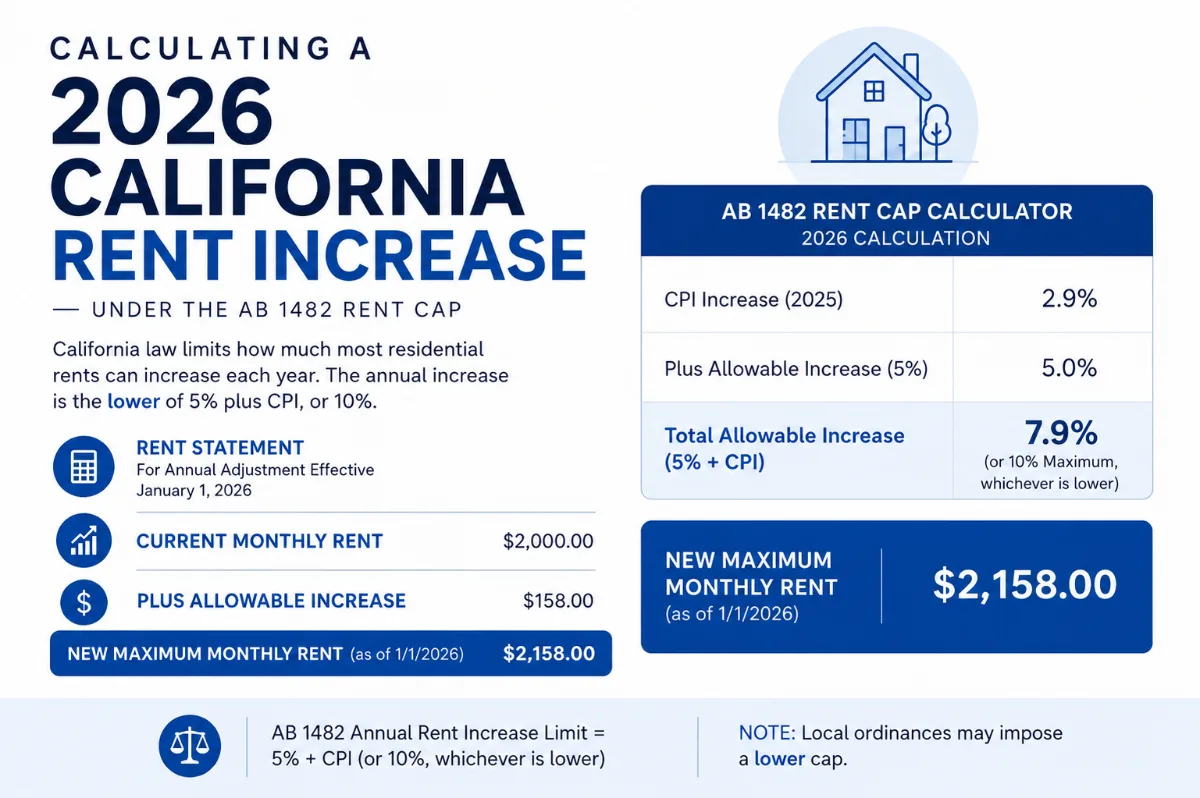
If you own a rental in California, “how much can I raise the rent?” is rarely a simple question. The answer depends on whether your property is covered by the state rent cap, what the current regional inflation figure is, and whether your city has its own stricter ordinance on top of state law. Get it wrong and a single improper notice can be challenged, reversed, or even expose you to penalties.
This guide explains the 2026 rules in plain English – the formula, how often you can raise rent, the notice periods, and the exemptions – with a worked example so you can sanity-check any increase before you serve it. It is general information, not legal advice, and is current as of July 2026.
The AB 1482 rent cap formula
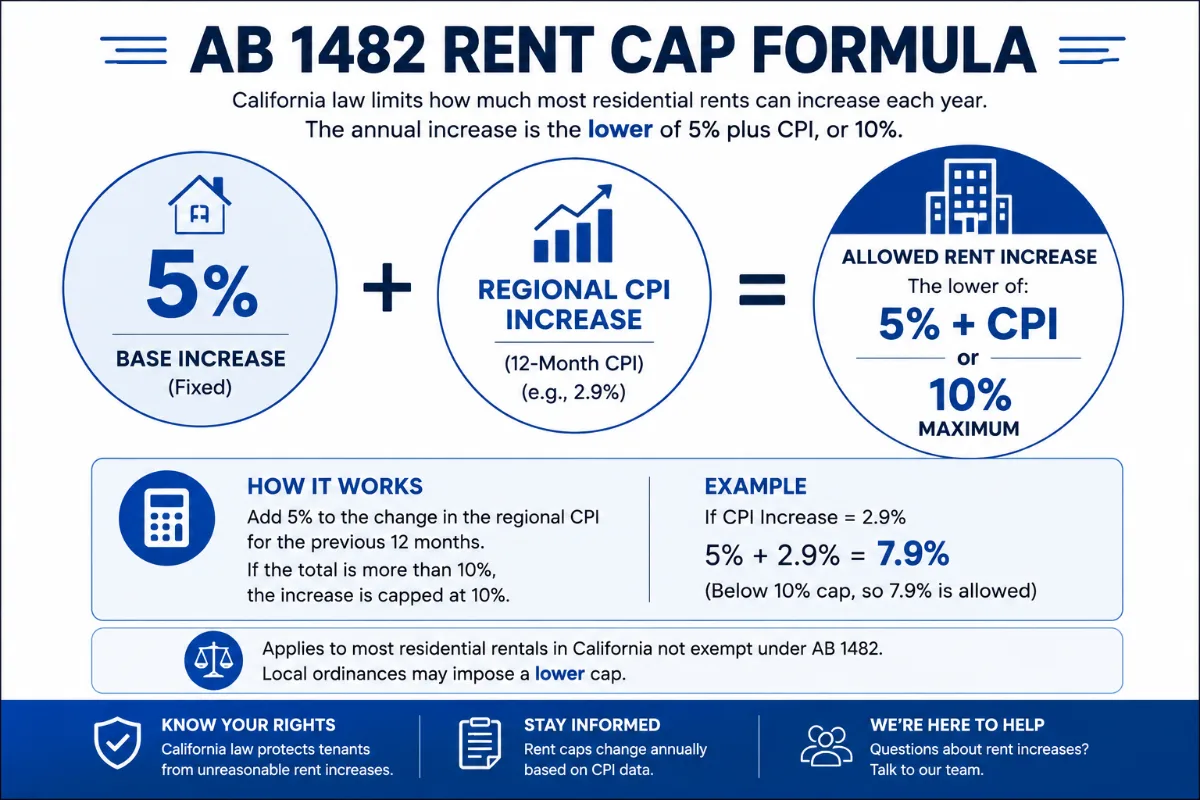
Most residential rentals in California fall under the Tenant Protection Act (AB 1482), which limits annual rent increases to 5% plus the regional Consumer Price Index (CPI), or 10% total – whichever is lower. In practice, the 10% ceiling is the hard stop because the allowed increase cannot exceed that maximum for covered properties.
The CPI figure is not a single statewide number. It is tied to the metro region your property sits in, and the percentage published in April applies to increases that take effect between August 1 and July 31 of the following year.
Don’t guess at the CPI. The California Apartment Association publishes the current regional figures, and the number for the Inland Empire, Riverside, San Bernardino, and Ontario may differ from Los Angeles, Orange County, or the Bay Area. Pull the current figure for your county before you calculate anything.
A worked example
Say you rent a covered single-family home in Riverside for $2,400/month, and the applicable cap for the current period is 8%. Here is the math:
- 8% of $2,400 = $192
- New maximum legal rent = $2,592/month
A landlord who tried to raise that rent to $2,800 – a 16.7% jump – would be well over the cap, and the increase would be unenforceable for the amount above $2,592. This is exactly the scenario behind the common search “can my landlord raise my rent $300?” On a $2,400 rent, $300 is 12.5% – over the cap for a covered unit.
How often can rent be raised?
On a covered property, you can raise rent no more than twice in a 12-month period, and the combined total of those increases still cannot exceed the cap. You cannot stack two separate increases to get around the annual limit.
On a fixed-term lease, rent generally stays locked until the term ends, unless the lease itself spells out a valid mid-term increase. Month-to-month tenancies are where most increases happen.
Notice periods you must follow
Even a perfectly legal increase fails if the notice is wrong:
- 30 days’ written notice for an increase of 10% or less in a 12-month period.
- 90 days’ written notice for any increase over 10% – which, on a covered property, is generally off the table because AB 1482 caps covered increases at 10%.
Notice must be properly served. If you mail it, California rules add extra days for service. Serving a notice a few days short is one of the most common – and most avoidable – mistakes owners make.
Which properties are exempt?
AB 1482’s percentage cap does not apply to every rental. Common exemptions include:
- Single-family homes and condos not owned by a corporation or REIT – but only if the owner gives the tenant the specific statutory exemption notice. Skip the notice and the property may be treated as covered.
- Housing built within the last 15 years, using the rolling date rule.
- Owner-occupied duplexes and certain owner-occupied situations.
Exempt does not mean “no rules.” You still owe proper written notice, you cannot raise rent in retaliation, and you cannot use an increase to discriminate or to push out a tenant unlawfully – issues we cover in our guide to what a landlord cannot do in California.
Don’t forget local ordinances
State law is the floor, not the ceiling. Cities such as Los Angeles, San Francisco, Oakland, and others have local rent stabilization ordinances that can be stricter than AB 1482. When a local rule is tougher, it governs. Always confirm whether your property’s city has its own cap before relying on the state number.
Management One handles compliant rent increases – correct caps, correct notices, correct timing – for owners across the Inland Empire, including Riverside property management and Orange County. We keep your lease aligned with the latest rules in our 2025-2026 legal shift guide and our security deposit law overview, and we always pull the current figure from the official AB 1482 CPI rent-cap figures before serving notice. The underlying rule lives in California Civil Code Section 1947.12 if you want the source text. Want us to handle it for you? You can talk to our team any time.
Frequently Asked Questions
How much can a landlord raise rent in California in 2026?
For properties covered by AB 1482, the annual increase is capped at 5% plus the regional Consumer Price Index (CPI), up to a maximum of 10% – whichever is lower. The CPI figure from April applies to increases that take effect between August 1 and July 31 of the following year. Always confirm the current regional figure before serving notice, and check for a stricter local ordinance.
How often can a landlord raise rent in California?
On a covered property, a landlord can raise the rent no more than twice in any 12-month period, and the combined increases still cannot exceed the 5% + CPI, max 10%, cap. On a fixed-term lease, rent generally cannot be raised until the term ends unless the lease allows it.
Can my landlord raise my rent $300 in California?
Only if that dollar amount stays within the percentage cap for a covered unit. For example, on $2,000 rent an 8% cap allows about $160, so a $300 jump, or 15%, would be illegal. On an exempt property – such as many single-family homes with the required exemption notice – there is no percentage cap, but proper notice is still required.
How much notice must a landlord give before raising rent?
California requires 30 days’ written notice for an increase of 10% or less in a 12-month period, and 90 days’ written notice for any increase above 10%, which generally only applies to exempt properties because AB 1482 caps covered units at 10%.
Is this article legal advice?
No. This is general information, not legal advice, and is current as of July 2026. Rent rules vary by city and by property, so confirm the current CPI figure and any local ordinance, or talk to our team, before serving a rent-increase notice.



Related Posts