
What a Landlord Cannot Do in California: Tenant & Owner Rights for 2026
California gives tenants some of the strongest protections in the country, and the list of things a landlord legally cannot do is long – and growing. For owners, crossing one of these lines can mean a lost case, statutory penalties, and damages. For tenants, knowing these limits is the difference between accepting an illegal demand and pushing back.
This pillar guide lays out the major restrictions in plain English: illegal entry, retaliation, lockouts, discrimination, deposit misuse, and the just-cause eviction rules. It is general information, not legal advice, and is current as of July 2026.
This article is for general informational purposes only and is not legal advice. California rental laws can vary by property type, city, lease terms, and specific situation. Owners and tenants should confirm current requirements before making decisions.
A landlord cannot enter whenever they want
A landlord does not have free run of an occupied rental. Under California Civil Code, they must give at least 24 hours’ written notice and enter only during normal business hours, for a legitimate purpose – repairs, agreed services, inspections, or showing the unit to prospective tenants or buyers.
The narrow exceptions are a genuine emergency such as a fire, flood, or gas leak, when the tenant has abandoned the unit, or by mutual agreement. The entry rule is set out in California Civil Code Section 1954, and the state’s California Attorney General tenant rights page summarizes it for renters. Repeatedly entering without proper notice can violate the tenant’s right to quiet enjoyment and even amount to harassment.
A landlord cannot use “I own it” as a reason to drop by. No proper notice, no valid purpose, no entry – except a true emergency.
A landlord cannot retaliate
It is illegal to punish a tenant for exercising a legal right – reporting a code violation, requesting a needed repair, or joining a tenants’ organization. California presumes retaliation if a landlord takes adverse action, such as a rent hike, an eviction notice, or reduced services, within 180 days of the tenant’s protected activity.
A landlord cannot lock you out or force you out
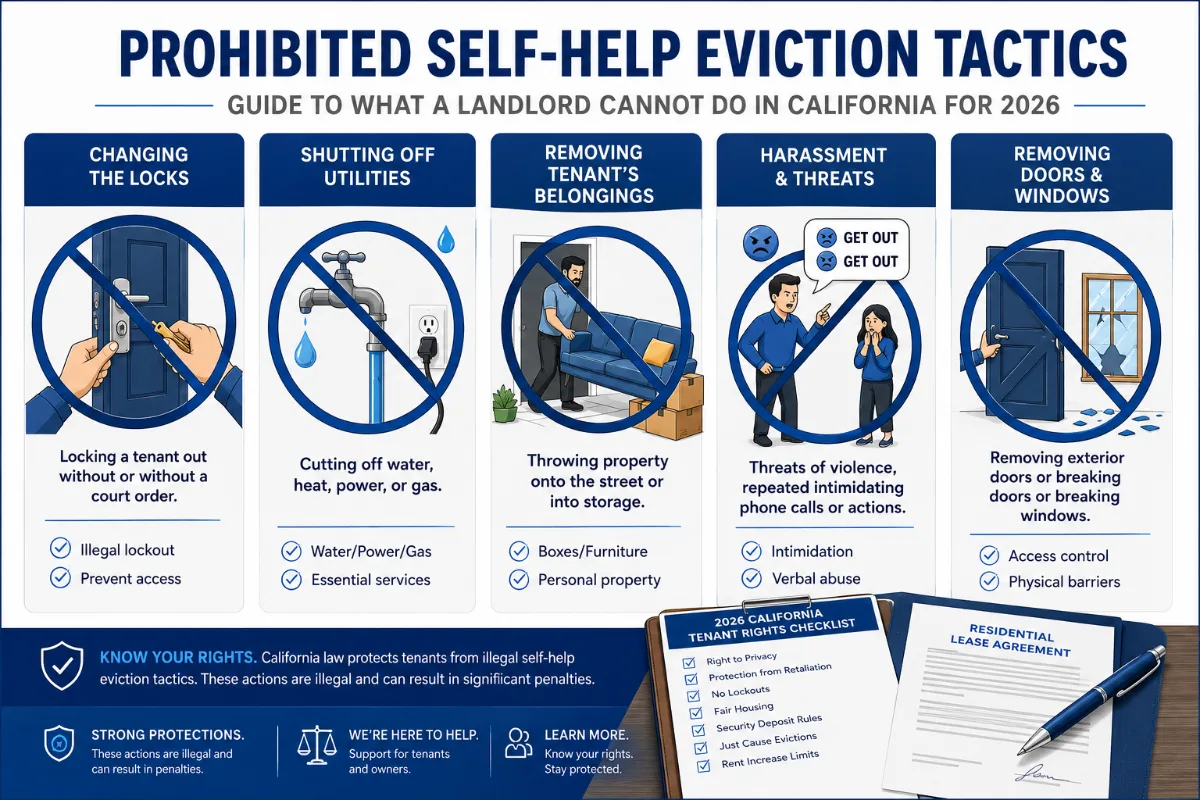
So-called self-help evictions are flatly illegal. A landlord cannot:
- Change the locks to keep a tenant out
- Shut off utilities such as water, power, or gas to drive a tenant away
- Remove doors or windows
- Put the tenant’s belongings on the curb
The only lawful way to remove a tenant is the formal court unlawful detainer eviction process. Skipping it exposes the owner to significant damages.
A landlord cannot discriminate
State and federal Fair Housing law bars discrimination based on race, color, religion, national origin, sex, familial status, disability, sexual orientation, gender identity, ancestry, marital status, and – in California – source of income, which includes Section 8 housing vouchers. A landlord cannot reject an applicant simply because they pay with a voucher; see our guide to Section 8 in California for the details.
Discrimination also extends to assistance animals: a landlord generally cannot deny a reasonable accommodation for a service animal or emotional support animal, even under a no-pets policy.
A landlord cannot misuse the security deposit
The deposit rules tightened sharply under AB 12. A landlord cannot:
- Charge more than one month’s rent as a deposit for most properties
- Deduct for ordinary wear and tear
- Keep the deposit without an itemized statement, due within 21 days of move-out
Skipping the required move-in and move-out documentation in bad faith can forfeit the landlord’s right to keep any of the deposit. Full details are in our security deposit law guide.
A landlord cannot evict or refuse to renew without just cause
Under AB 1482, once a tenant has occupied a covered unit for 12 months, the landlord needs just cause to end the tenancy:
- At-fault just cause – nonpayment of rent, lease violations, nuisance, or similar tenant-caused issues.
- No-fault just cause – owner or family move-in, substantial remodel, withdrawal from the rental market, or similar qualifying reasons, which generally require relocation assistance, often one month’s rent.
Because non-renewal of a long-term covered tenancy is treated as a termination, a landlord generally cannot just decline to renew without one of these reasons. A tenant who needs to leave early has their own rules, covered in how to break a lease in California.
A landlord cannot raise rent however they like
Rent increases on covered properties are capped by AB 1482 at 5% plus regional CPI, max 10%, with strict notice rules. A landlord cannot spring an oversized or improperly noticed increase – the full mechanics are in our guide to how much a landlord can raise rent in California.
Management One keeps owners across the Inland Empire and Orange County compliant – proper notices, lawful entries, clean deposit handling, and just-cause-ready documentation – so a simple misstep never becomes a lawsuit. Want a partner who knows these rules cold? You can talk to our team any time.
Frequently Asked Questions
Can a landlord enter without permission in California?
Generally no. A landlord must give at least 24 hours’ written notice and enter only during normal business hours, for a valid reason such as repairs, inspections, or showings. The main exception is a genuine emergency like a fire or burst pipe. Entering without notice can violate the tenant’s right to quiet enjoyment.
Can a landlord evict you for no reason in California?
Usually no. Under the Tenant Protection Act, also known as AB 1482, once a tenant has lived in a covered unit for 12 months, the landlord needs just cause to end the tenancy – either an at-fault reason, like nonpayment, or a no-fault reason, like an owner move-in. Relocation assistance is generally required for no-fault evictions.
Can a landlord refuse to renew a lease in California?
For a covered tenancy past 12 months, a landlord generally cannot simply decline to renew without a just-cause reason – non-renewal is treated like a termination. And a landlord can never refuse to renew in retaliation or for a discriminatory reason.
What can a landlord NOT do with my security deposit?
A landlord cannot charge more than one month’s rent under AB 12 for most properties, cannot deduct for ordinary wear and tear, and must return the deposit with an itemized statement within 21 days of move-out. Failing to document deductions in good faith can cost the landlord the right to keep any of it.
Is this article legal advice?
No. This article is for general informational purposes only and is current as of July 2026. California rental laws can vary by city, property type, lease terms, and specific situation.


Related Posts